
The cash deposited in your bank after selling a rental property is not your net profit; it’s a future tax liability in disguise.
- Your true cost base (ACB) includes far more than the purchase price, requiring ‘financial archaeology’ to unearth forgotten fees and renovation costs.
- Capital Cost Allowance (CCA) recapture is a hidden tax bill, taxed at your full marginal rate, not the lower capital gains rate.
Recommendation: Before spending a single dollar of the sale proceeds, build a detailed projection of your total tax liability (capital gains and recapture) to avoid a severe cash-flow crisis next April.
For any Quebec property investor, the moment the sale of a rental building closes feels like a major victory. A substantial sum hits your bank account, representing years of appreciation and management. The natural impulse is to earmark that cash for the next down payment, a new investment, or a long-overdue reward. This is a critical error. That gross figure is a mirage; a significant portion of it already belongs to the government. The central challenge isn’t just calculating the capital gains tax—it’s about projecting your true, final net-worth position after all liabilities are settled.
Most investors focus on the basics: the 50% capital gains inclusion rate and the initial purchase price. This superficial approach is what leads to the “phantom cash” crisis—the shocking discovery in April that the tax bill is far larger than anticipated, often because of a misunderstood cost base and a completely forgotten second tax bill called CCA recapture. A fiscal projectionist doesn’t just calculate tax; they model cash flow. This means treating the sale not as a single taxable event, but as the resolution of multiple financial timelines.
This guide abandons the simplistic approach. We will deconstruct the calculation from a net-worth preservation perspective. We’ll perform the necessary ‘financial archaeology’ to establish your true cost base, distinguish value-adding renovations from simple repairs, and model the impact of tax-deferral strategies. The goal is to transform you from a passive taxpayer into a strategic projectionist who knows, down to the dollar, what you truly own versus what you merely hold for the tax authorities.
This article provides a detailed breakdown of each component needed to accurately project your tax liability. Follow this guide to understand the critical variables that determine the actual cash you will keep.
Summary: Calculating Real Capital Gains Tax on Quebec Rental Properties
- Notary fees and transfer duties: The expenses you forgot to add to your cost base (ACB)
- Renovations vs. Repairs: Which receipts actually lower your capital gain?
- 50% (or more?): How the inclusion rate affects your marginal tax bracket
- Selling the losers: How to use stock market losses to wipe out real estate gains
- The “phantom cash” problem: Why you shouldn’t spend the sale proceeds until April
- Depreciation is a loan, not a gift: Why the government wants its money back now
- The “small business deduction” trap: When rental income is taxed at 50%
- The Hidden Tax Bill: Understanding CCA Recapture on Property Sale
Notary fees and transfer duties: The expenses you forgot to add to your cost base (ACB)
The first step in calculating your capital gain is determining your Adjusted Cost Base (ACB). Many investors mistakenly believe the ACB is simply the purchase price of the property. This is a costly oversight. The ACB is the total capital cost of acquiring the asset, and accurately calculating it is a process of ‘financial archaeology’—digging through old files to find every eligible expense that legally increases your cost basis and, therefore, reduces your taxable gain.
Your search should begin with the closing documents from the initial purchase. Key items to add to your ACB include the Quebec Land Transfer Tax (often called the “taxe de bienvenue” or welcome tax), legal and notary fees, and any survey or appraisal costs incurred during the acquisition. For a typical rental property purchase in the province, industry data shows that notary fees in Quebec typically range from $1,500 to $3,000, a significant sum you can add to your cost base. Real estate agent commissions paid at the time of sale are also deducted from the proceeds, having a similar effect.
It’s equally important to know what not to include. Current expenses like routine maintenance, property taxes, or mortgage interest are deducted annually against rental income; they do not form part of the ACB. Misclassifying a current expense as a capital expense (or vice versa) can lead to an incorrect gain calculation and potential issues with Revenu Québec and the CRA.
Action Plan: Your ACB Document Retrieval Checklist
- Locate the original deed of sale and closing statement to identify all acquisition costs.
- Gather receipts for notary fees, legal fees, and the Quebec welcome tax (“taxe de bienvenue”).
- Include any surveyor fees, certificates of location, and title insurance premiums paid at purchase.
- Compile all invoices for major renovations that improve the property (not minor repairs).
- Set aside records for current expenses (e.g., maintenance, property taxes) as they are not part of the ACB.
Renovations vs. Repairs: Which receipts actually lower your capital gain?
Once you’ve established the initial acquisition costs, the next layer of your financial archaeology involves sifting through years of property expenditures. The critical distinction you must make is between a capital expenditure (renovation) and a current expense (repair). Only renovations can be added to your ACB, directly reducing your capital gain. A repair, on the other hand, is a deductible expense against rental income in the year it was incurred.
A renovation is an outlay that provides a lasting benefit or improves the property beyond its original condition. Examples include replacing an entire roof, finishing a basement, adding a new bathroom, or fundamentally upgrading the electrical or plumbing systems. These are significant investments that increase the property’s value or extend its useful life. In contrast, a repair is work done to restore the property to its previous condition. Fixing a leaky faucet, patching a small section of drywall, or replacing a broken windowpane are all repairs. They maintain the property but don’t enhance it.
This distinction is vital for your net-worth projection. An investor who spent $50,000 on a new kitchen (a renovation) can add that full amount to their ACB. If their capital gain was $200,000, it is now reduced to $150,000, saving them thousands in tax. An investor who spent the same amount over a decade on minor repairs cannot. Their ACB remains unchanged, and they face a larger taxable gain. Diligent record-keeping and correct classification are not just an accounting exercise; they are an active strategy to protect your capital.
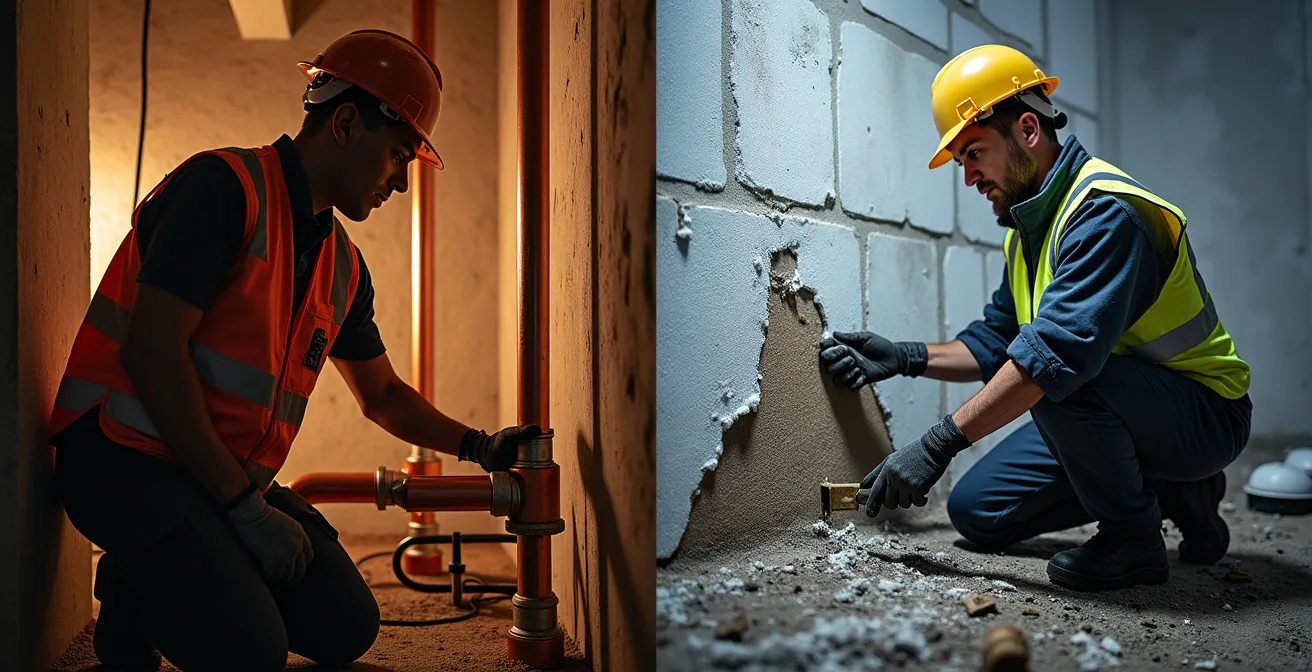
As the image illustrates, there is a fundamental difference between overhauling a building’s core infrastructure and performing simple maintenance. Understanding this difference is key to optimizing your tax position. Every dollar correctly classified as a capital expenditure is a dollar that works to reduce your final tax bill upon sale.
50% (or more?): How the inclusion rate affects your marginal tax bracket
Once you have calculated your capital gain (Proceeds of Disposition minus the Adjusted Cost Base), the next step is to determine the taxable portion. The rule most investors know is the capital gains inclusion rate, which for many years has been 50%. This means only half of your capital gain is added to your income for the year. However, this is where a projectionist’s thinking diverges from a simple calculation. The true impact is not the 50% rate itself, but how that newly added taxable income interacts with your marginal tax brackets.
Adding, for example, $100,000 of taxable capital gain to your income can push you from a 37% marginal tax bracket into the highest bracket, where your total income is taxed at a much higher rate. In Quebec’s highest income bracket, the effective capital gains tax rate on that gain isn’t a simple percentage; it is the result of the inclusion rate multiplied by your highest marginal rate. This currently means the tax can be as high as 26.66% of the total gain. For high-income earners, this is the most realistic number to use for projections.
Furthermore, these rates are not static. The federal government recently proposed increasing the inclusion rate to two-thirds (66.67%) for capital gains over $250,000. While its implementation has been deferred, this proposal signals a clear direction from policymakers. A fiscal projectionist must account for this potential future reality.
The following table, based on information from Revenu Québec regarding recent federal proposals, illustrates the evolving landscape of inclusion rates.
| Period | Inclusion Rate (First $250k) | Inclusion Rate (Above $250k) | Status |
|---|---|---|---|
| Before June 25, 2024 | 50% | 50% | Implemented |
| Originally Proposed (June 25, 2024) | 50% | 66.67% | Deferred |
| Current (2024-2025) | 50% | 50% | Active |
| Proposed (Jan 1, 2026) | 50% | 66.67% | Under Review |
Selling the losers: How to use stock market losses to wipe out real estate gains
A strategic investor manages their entire portfolio, not just individual assets. When facing a large capital gain from a real estate sale, one of the most powerful tools for reducing your tax bill is tax-loss harvesting. This involves strategically selling other investments, such as stocks or mutual funds, that are currently at a loss. The capital losses realized from these sales can be used to directly offset the capital gains from your property sale on a dollar-for-dollar basis.
The rules governing this are surprisingly flexible and offer a significant strategic advantage. As explained by tax specialists like H&R Block Canada, you are not limited to using losses realized in the same year as the gain. You can carry capital losses back up to three years to amend previous tax returns or carry them forward indefinitely to offset future gains. This flexibility is a projectionist’s dream. For instance, if you sell your rental property in November, you have until December 31st of that year to review your stock portfolio and realize any ‘paper’ losses to neutralize the real estate gain for that tax year.

This isn’t about market timing; it’s about tax timing. You may decide to sell a stock that is underperforming not because you’ve lost faith in its long-term prospects, but because its current ‘paper’ loss has more value to you today as a tax shield than its potential for future recovery. It transforms a poorly performing asset into a tool for de-risking the financial outcome of your successful property sale, directly increasing the net cash you get to keep.
The “phantom cash” problem: Why you shouldn’t spend the sale proceeds until April
This brings us to the most dangerous trap for a property investor: the “phantom cash” problem. This occurs when an investor receives the gross proceeds from a sale, perceives it as disposable capital, and commits it to another investment or major purchase before settling their tax bill. The cash in your account in November is not entirely yours. A large portion is a liability you owe to the government, due the following April.
The magnitude of this liability is frequently underestimated. Investors fixate on the 50% inclusion rate, forgetting that the final bill is a combination of multiple factors. When you combine the federal and provincial taxes on the capital gain, and then add the often-forgotten CCA recapture (which we will cover next), the total tax payable can be staggering. In some scenarios, combined federal and Quebec taxes can reach up to 53.31% on your highest dollars of income. Imagine a $300,000 capital gain; the tax on that alone could be over $75,000, and this doesn’t even include the recapture bill.
The “phantom cash” crisis materializes when an investor, having already spent the sale proceeds, is presented with a six-figure tax bill from their accountant. They have no liquid cash to pay it, forcing them to sell other assets under pressure, take out a loan, or face severe penalties from the tax authorities. The only defense against this is to act like a fiscal projectionist. You must calculate an accurate estimate of your total tax liability *before* the sale, and then immediately segregate that estimated amount from the proceeds into a separate, untouchable account until your taxes are filed and paid.
Depreciation is a loan, not a gift: Why the government wants its money back now
For years, you may have been claiming Capital Cost Allowance (CCA), or depreciation, against your rental income. This is an optional deduction that allows you to expense a portion of the building’s cost over time, reducing your annual taxable rental income. While this provides valuable tax relief year after year, it is crucial to understand its true nature: CCA is a tax deferral, not a tax forgiveness. It is a loan from the government, and at the time of sale, they come to collect.
Every dollar of CCA you claim reduces the “book value” of your property, known as the Undepreciated Capital Cost (UCC). For example, if you bought a building for $500,000 and claimed $80,000 in CCA over the years, your UCC is now $420,000. This is the figure the government uses to measure your property’s value for tax purposes. When you sell the property for more than its UCC, a reckoning occurs.
The government’s logic is that you received a tax break based on the assumption the building was losing value. If you sell it for more than this depreciated value, you must “recapture” the depreciation you claimed and pay tax on it. This is not a capital gain; it’s fully included in your income and taxed at your highest marginal rate. The flip side is also true: if you sell for less than the UCC, you may have a “terminal loss,” which, unlike a capital loss, can be 100% deductible against other income. The decision to claim CCA is therefore a strategic one, weighing short-term tax savings against a potentially massive future tax liability.
The “small business deduction” trap: When rental income is taxed at 50%
For investors who hold their rental properties within a corporation, a specific and devastating tax trap exists. Many assume their corporation will benefit from the low corporate tax rate available via the Small Business Deduction (SBD). This is generally not the case for rental income. Tax authorities draw a sharp line between “active business income” and “passive investment income,” and the consequences for being on the wrong side of that line are severe.
An active business is one that, for example, manufactures a product or provides a service. In Quebec, its income may be taxed at a low combined rate of around 12.2%. Rental income, however, is typically classified as “Specified Investment Business” income, which is a form of passive income. This type of income is explicitly not eligible for the SBD and is instead taxed at the highest corporate rate, which in Quebec is approximately 50.17%. A key exception exists: if the corporation employs more than five full-time employees to manage its properties, the rental income can be considered active. For the vast majority of small-scale investors, this threshold is never met.
Misunderstanding this rule can lead to a disastrous tax projection. An investor expecting to pay 12% tax on their rental profits (including any CCA recapture at the corporate level) will instead face a bill four times larger. This distinction is one of the most important for incorporated landlords to understand.
This table, based on data from the Canada Revenue Agency, starkly contrasts the two scenarios.
| Income Type | Quebec Corporate Tax Rate | Dividend Type | Eligibility Criteria |
|---|---|---|---|
| Active Business Income | ~12.2% | Eligible Dividends | More than 5 full-time employees |
| Specified Investment Business | ~50.17% | Non-eligible Dividends | 5 or fewer full-time employees |
Key takeaways
- Your Adjusted Cost Base (ACB) is not just the purchase price; it includes acquisition costs and major renovations, which directly reduce your taxable gain.
- Capital Cost Allowance (CCA) Recapture is a separate tax liability from capital gains. It is 100% taxable as regular income at your highest marginal rate.
- The final tax bill is a combination of two distinct liabilities (capital gains tax and recapture tax), which can easily create a ‘phantom cash’ crisis if you spend the sale proceeds prematurely.
The Hidden Tax Bill: Understanding CCA Recapture on Property Sale
We’ve established that depreciation is a loan. The CCA Recapture is the government’s collection mechanism. This is the second, often forgotten, tax bill that arrives alongside your capital gains tax. It is frequently the source of the “phantom cash” crisis because it is taxed far more punitively than a capital gain. While a capital gain is only 50% taxable, the CCA recapture amount is 100% taxable, added directly to your income and subject to your highest marginal tax rate.
The calculation is triggered when you sell a property for more than its Undepreciated Capital Cost (UCC), but for less than its original purchase price. As detailed in examples from Revenu Québec on selling a rental property, the mechanics are best understood with a clear scenario:
Imagine you sell a property for $500,000. You originally purchased it for $400,000 (your ACB, for simplicity). Over the years, you claimed $50,000 in CCA.
- Original Cost (ACB): $400,000
- Undepreciated Capital Cost (UCC): $400,000 – $50,000 (CCA claimed) = $350,000
- Proceeds of Disposition: $500,000
In this case, you have two separate taxable events:
- CCA Recapture: The lesser of the proceeds ($500k) or original cost ($400k), minus the UCC ($350k). This is $400,000 – $350,000 = $50,000 of Recapture. This full $50,000 is added to your income.
- Capital Gain: The proceeds ($500k) minus the original cost ($400k) = $100,000 of Capital Gain. Of this, 50% ($50,000) is added to your income.
Your total taxable income from this sale is $50,000 (recapture) + $50,000 (taxable capital gain) = $100,000. The failure to account for the recapture portion is what leads to catastrophic miscalculations of an investor’s net cash position.
Ultimately, a successful real estate investment cycle is not defined by the sale price, but by the net cash that remains after all tax obligations are met. By adopting the mindset of a fiscal projectionist—meticulously building your ACB, strategically managing capital losses, and, most importantly, planning for the inevitable CCA recapture—you can protect your capital from unpleasant surprises and position yourself for your next profitable venture. Your next step should be to build a clear projection of these liabilities before making any decisions with your sale proceeds.