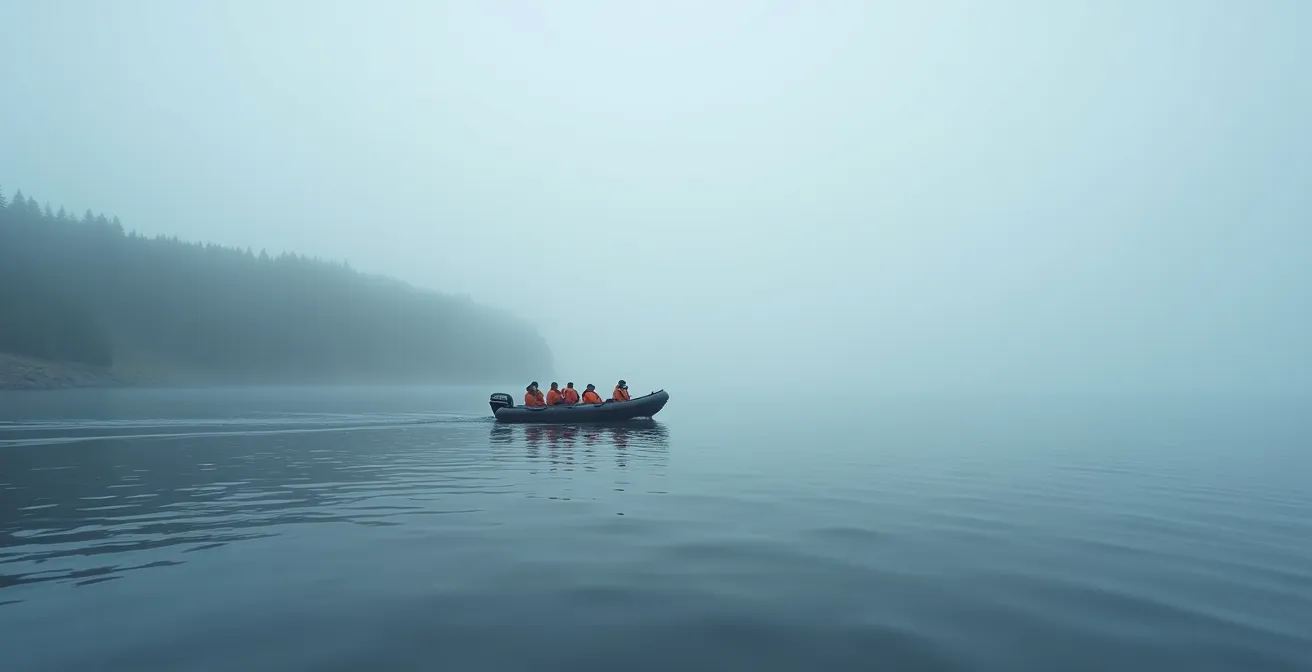
Beating seasickness on a Gaspé whale tour isn’t about luck or just taking a pill; it’s about proactively engineering your success by understanding physics and biology.
- Vessel stability is not just about size. It’s about matching the boat’s motion (slow roll vs. fast slam) to the Gulf of St. Lawrence’s specific wave patterns.
- Effective thermoregulation and hydration are not just for comfort—they are scientific tools that directly lower your body’s susceptibility to nausea.
Recommendation: Choose your vessel and plan your preparation based on sea conditions and science, not just the tour brochure, to guarantee an incredible experience.
The dream of seeing a humpback breach the surface of the Gulf of St. Lawrence is powerful. For many, however, that dream is shadowed by a persistent fear: the debilitating grip of seasickness. The common advice feels like a roll of the dice—pop a Gravol, stare at the horizon, and hope for the best. This passive approach leaves your once-in-a-lifetime experience entirely to chance, turning a day of wonder into one of misery. Many travelers return from Gaspésie with tales of stunning whales they could barely appreciate, their focus consumed by the churn of their own stomach.
But what if you could take control? What if the key to a comfortable whale-watching trip wasn’t hope, but strategy? As a marine biologist and boat captain who has spent countless hours on these waters, I can tell you that a successful, nausea-free excursion is not a matter of luck. It’s a matter of making a series of informed, strategic decisions before you ever step on the dock. It’s about understanding the fundamental physics of how different boats handle the water, the science of how your body regulates temperature and hydration, and the biology of the very animals you seek to admire.
This guide moves beyond the platitudes. We will deconstruct the problem of motion sickness and provide you with a captain’s framework for planning your Gaspésie whale-watching tour. We will analyze vessel choice based on motion dynamics, establish the correct protocol for medication, detail a layering system designed for the maritime environment, and even discuss how ethical whale watching practices contribute to a better passenger experience. Your journey to seeing the whales of Gaspé starts not at the harbour, but here—with a plan.
To help you navigate these crucial decisions, this article is structured to provide clear, actionable strategies. The following sections break down everything you need to know to plan your excursion with the confidence of a seasoned mariner.
Summary: A Strategic Guide to a Seasickness-Free Gaspé Whale Tour
- Zodiac vs. Large Boat: Which one minimizes nausea in choppy Gulf waters?
- Why taking Gravol 30 minutes before departure is too late
- Blue Whales or Humpbacks: Which month offers the best sightings?
- The error of choosing a boat that chases whales too closely
- How the wind chill on the water drops 10°C even in July
- Sleeping bag technique: Why wearing too many layers actually makes you colder
- Water requirements: Why 1 liter is dangerous on the Acropole climb
- Chasing Fall Colors in the Eastern Townships: The Ultimate Drive
Zodiac vs. Large Boat: Which one minimizes nausea in choppy Gulf waters?
The single most important decision you will make is your choice of vessel. Many people mistakenly believe “bigger is always better,” but the reality is about matching the boat’s motion physics to the sea conditions. The Gulf of St. Lawrence is known for its long, rolling swells, not short, sharp chop. This is a critical distinction. A large, heavy-keeled boat (40+ passengers) will gently roll and sway with these long swells, a predictable motion that is far easier for the inner ear to adapt to. In contrast, a Zodiac, being light with a flat bottom, will slam and shudder on top of the waves. This jarring, high-frequency motion is a primary trigger for severe motion sickness.
Forillon National Park provides a perfect real-world example. Operators like Croisières Baie de Gaspé offer both the Narval III (a 47-passenger vessel) and the Rocher Le Vieux (a 12-passenger Zodiac). For a person prone to seasickness in the Gulf, the Narval III is unequivocally the superior choice due to its stability in the region’s characteristic swells. While a Zodiac offers an exhilarating, close-to-the-water experience on a perfectly calm day, it poses a significant risk on a typical Gaspésie day. Your goal is to see whales comfortably, not to endure an extreme sport.
The following table, based on an analysis of vessel types in the Gulf of St. Lawrence, breaks down the key differences in motion and stability. As shown in the data from an analysis of whale watching in maritime Québec, the choice is clear for those prioritizing comfort.
| Vessel Type | Motion Type | Best For | Worst For | Stability Rating |
|---|---|---|---|---|
| Large Boat (40+ passengers) | Slow, deep rolling | Long swells, Gulf waters | Quick direction changes | 7/10 |
| Zodiac (12-20 passengers) | Fast slamming, jarring | Calm days, close encounters | Choppy Gulf conditions | 4/10 |
| Mid-size (20-40 passengers) | Moderate rolling | Mixed conditions | Heavy swells | 6/10 |
Furthermore, the most stable part of any boat is low and at the stern, near the engines. When booking, always request a seat at the back. The bow of the boat experiences the most dramatic vertical movement and should be avoided at all costs.
Why taking Gravol 30 minutes before departure is too late
The second pillar of your anti-seasickness strategy is pharmacology, and the most common mistake is timing. Taking a preventative medication like Dimenhydrinate (Gravol) or Meclizine (Bonine) as you’re walking down the dock is effectively useless. Once the feeling of nausea begins, your stomach’s absorption process slows dramatically, and the medication will not enter your system in time to help. It is a preventative measure, not a cure.
To be effective, these medications need to be fully integrated into your bloodstream before you are exposed to the motion. Based on clinical data, pharmacology research confirms that dimenhydrinate requires at least 60 to 90 minutes before boarding to reach effective levels. This is the absolute minimum. For those who are highly susceptible, a more robust protocol is required. This insight is not just theoretical; it’s a best practice shared by the most experienced operators.

As you can see, timing is everything. Experienced charter captains and whale-watching guides have developed a near-unanimous recommendation based on years of observation, a protocol that goes far beyond the instructions on the box. As one seasoned operator advises:
First do take an over-the-counter preparation such as Bonine or Dramamine the night before AND the morning of the cruise. The medication needs time to get into your system.
– Experienced whale watching operators, TripAdvisor Dolphin Fleet Whale Watch Forum
This “night before” dose ensures the medication is at a stable level in your system when you wake up, and the “morning of” dose (taken at least 90 minutes before departure with a small, non-greasy snack) reinforces that protection. This proactive, two-stage approach is the single most effective way to use over-the-counter aids.
Blue Whales or Humpbacks: Which month offers the best sightings?
Planning your trip also involves understanding the seasonal ebb and flow of whale populations. The question isn’t simply “when is the best month,” but rather “what is the trade-off between species diversity and weather conditions?” The Gaspésie whale-watching season broadly runs from May to October, and during this time, up to seven different species are observable depending on food availability.
Early in the season, like June, the weather and sea conditions are often calmer—a significant plus for the seasick-prone. However, the diversity and number of whales are typically lower. You are likely to see Minke whales and Fin whales, but the more acrobatic Humpbacks are just beginning to arrive. As the summer progresses, the food chain in the Gulf becomes more robust, attracting a greater number of animals.
The peak period for both diversity and density of whales is late August through September. This is your best window to see not only Fin whales and Humpbacks but also potentially the largest animal on earth, the magnificent Blue whale. The deep underwater channel at the edge of Forillon National Park (best accessed from Gaspé harbour) is a prime feeding ground for these great whales. Waters near Percé, while also rich, tend to be better for observing Humpback and Minke whale activity. So, if seeing a Blue whale is your ultimate goal, a trip from Gaspé in September is your highest probability bet.
However, this peak biological activity comes with a trade-off: September weather can be more unpredictable, with a higher chance of wind and larger swells. This is where your vessel choice becomes paramount. A trip in September on a large, stable boat offers the best of both worlds: maximum whale-sighting potential with a vessel capable of handling the conditions. A trip in June offers calmer seas but potentially fewer sightings. Your decision should be based on your personal risk tolerance for both seasickness and missing out on certain species.
The error of choosing a boat that chases whales too closely
An often-overlooked factor in passenger comfort is the captain’s behaviour. A boat that aggressively “chases” whales—speeding up, making sharp turns, and cutting them off—creates a chaotic and unpredictable motion profile that is guaranteed to induce nausea. Conversely, a boat operated by an ethical, patient captain who respects the animals’ space provides a much smoother and more enjoyable ride.
Ethical whale watching isn’t just better for the whales; it’s better for the passengers. In Canada, a minimum distance of 100 metres must be maintained from most whale species (200 metres in some specific zones). A responsible operator will slow down or stop the vessel at this distance, allowing the engine noise to drop and the boat’s motion to stabilize. This patient approach not only minimizes disturbance to the animals but also creates a more stable platform for passengers. As a guide at Forillon National Park eloquently puts it:
The most magical encounters happen when we respect the whales’ space and let their natural curiosity bring them to us, not when we chase them.
– Marine Biologist Guide, Parks Canada Forillon National Park
This philosophy directly translates to a better experience for you. When a boat sits quietly in the water, a curious Humpback may choose to approach on its own, providing a breathtaking and stable viewing. To ensure you choose such an operator, you must do your homework and ask the right questions before you book.
Your Pre-Booking Checklist: Questions for Your Tour Operator
- Certification: Are you certified by a recognized eco-tourism body like the Alliance Éco-Baleine? This signals a commitment to responsible practices.
- Stress Protocol: What is your protocol if a whale appears stressed or changes its behaviour because of the boat’s presence? A good operator will immediately back off.
- Coordination: How do you coordinate with other boats on the water to avoid crowding an animal? Responsible fleets communicate to manage their impact.
- Educational Component: Do your guides explain the importance of the local ecosystem, such as why Forillon is a critical feeding ground for great whales?
- Approach Policy: What are your company’s specific approach distances and policies for different species, beyond the legal minimum?
Choosing an operator who prioritizes the whales’ well-being is a direct investment in your own comfort. A calm boat is a stable boat.
How the wind chill on the water drops 10°C even in July
The third pillar of your strategy is effective thermoregulation. Feeling cold is not just a matter of discomfort; it is a physiological stressor that significantly lowers your threshold for nausea. Even on a warm 25°C day in Gaspé, the temperature on the open water of the Gulf can feel 10 to 15 degrees colder due to wind chill, especially from the notorious ‘Noroît’ (north-west) wind that sweeps down the St. Lawrence estuary.
The mistake is dressing for the weather on land, not for the marine environment. Operators consistently report that passengers who get cold are far more likely to become seasick. Proper layering is not just a suggestion; it is a critical component of your anti-nausea toolkit. The goal is to trap a layer of warm air next to your body while allowing moisture (sweat) to escape. This requires a specific, “Gaspésien-style” system.
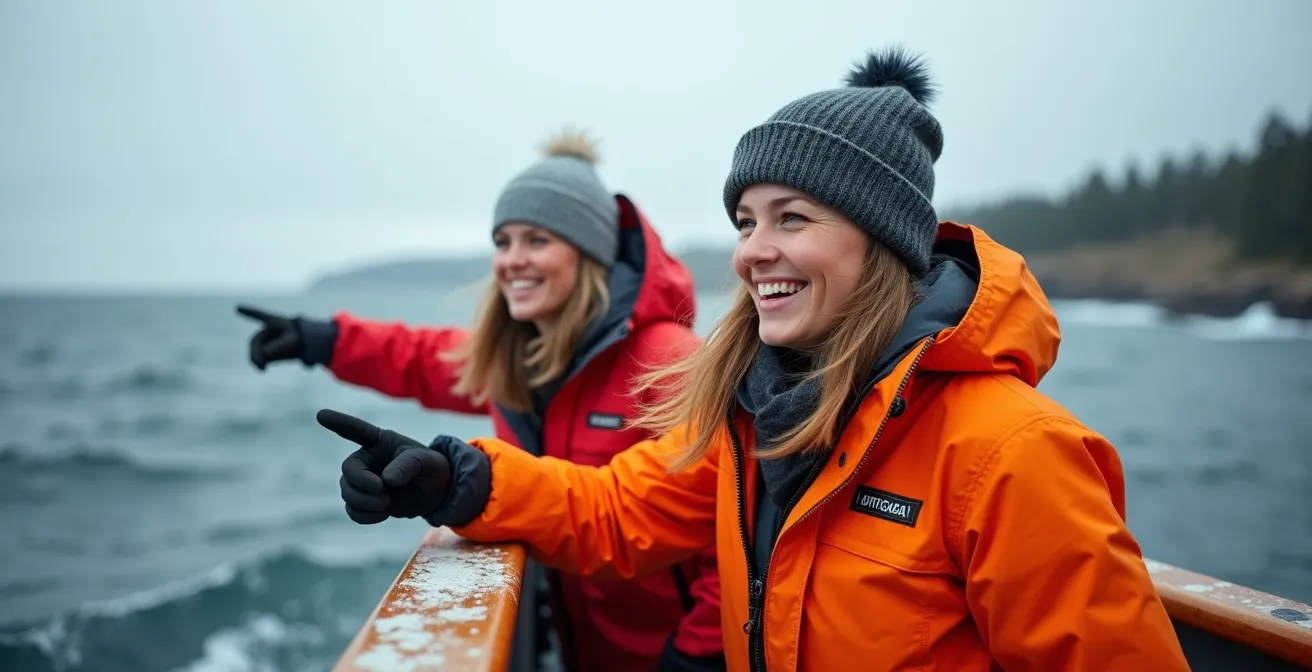
As the image above illustrates, seasoned visitors come prepared for a dramatic temperature drop. The right clothing acts as your personal defense system against the elements that exacerbate seasickness. Here is the non-negotiable layering system you must adopt:
- Base Layer: A snug-fitting shirt made of merino wool or a synthetic, moisture-wicking fabric. Never wear cotton as a base layer; it holds moisture against your skin and makes you cold.
- Mid Layer: This is your insulation. A fleece jacket or a light down vest is ideal. The goal is to trap air without being bulky.
- Outer Shell: A high-quality waterproof and, most importantly, windproof jacket. This is your shield against the wind and sea spray.
- Accessories: Do not underestimate the importance of a warm beanie (a ‘tuque’ as we say in Québec), waterproof gloves, and a neck gaiter or scarf. A huge amount of body heat is lost through your head and neck.
Some Quality-Safety certified businesses may provide additional weather gear, but you should never rely on it. Arriving with your own complete layering system ensures you remain warm, dry, and comfortable, giving your body the best possible defense against the onset of nausea.
Sleeping bag technique: Why wearing too many layers actually makes you colder
Building on the principle of layering, we must address a common and counterintuitive error: “compression cold.” Many people think that piling on as many thick, tight layers as possible is the key to staying warm. This is incorrect and works against you, much like wearing too many clothes inside a sleeping bag can actually make you colder. The principle of insulation is not the material itself, but the air it traps. This is known as ‘loft’.
When you wear multiple bulky or tight layers (like a thick cotton hoodie under a tight rain jacket), you compress the materials and squeeze out the trapped air. This eliminates the insulating gap and dramatically reduces your warmth. Worse, this compression prevents moisture from escaping. You begin to sweat, even if you feel cold, and that moisture gets trapped in your inner layers. This dampness is a warmth-killer; in fact, studies show that damp clothing from trapped sweat reduces insulation efficiency by over 25%.
Once your clothes are damp, you are in a losing battle against the cold. Your body expends a massive amount of energy trying to stay warm, leading to fatigue. This combination of being cold, damp, and fatigued is a potent recipe for seasickness. Maritime tour operators consistently observe that passengers dressed in bulky, compressive layers complain of nausea, dizziness, and fatigue far more often than those wearing a proper, loose-fitting technical layering system. Your layers should be distinct and have space between them to trap air effectively. Think like a well-insulated house, not a vacuum-sealed package.
Therefore, the goal is not maximum layers, but maximum trapped air. Choose a fleece that is fluffy, not dense. Ensure your outer shell is large enough to fit comfortably over your mid-layer without compressing it. This “sleeping bag technique”—prioritizing loft over bulk—is the secret to staying warm and dry on the water, which in turn is a secret to staying well.
Water requirements: Why 1 liter is dangerous on the Acropole climb
The title of this section references a famous, strenuous hike in Québec’s Charlevoix region, but the principle it highlights is universal and even more critical on the open water. Just as arriving for the Acropole des Draveurs trail with a single litre of water is dangerously inadequate, underestimating your hydration needs for a whale-watching tour is a significant mistake. Dehydration is a major, often-ignored trigger for motion sickness.
There are two reasons for this. First, the primary medications used to prevent seasickness, such as Gravol and Bonine, are known to be dehydrating. You are already starting at a disadvantage. Second, your body’s equilibrium system is more sensitive when you are dehydrated. Research has shown that even mild dehydration can cause a 40% increase in nausea and dizziness symptoms when exposed to motion. The cool, windy air on the boat can also trick you into thinking you aren’t losing fluids, but you are constantly losing moisture through respiration.
A single bottle of water is not a hydration strategy; it’s a token gesture. You must adopt a sailor’s protocol for hydration. This means starting the process long before you leave and maintaining it correctly throughout the trip.
- Start 24 Hours Early: Begin actively hydrating the day before your excursion. Your goal is to be fully hydrated when you wake up, not to play catch-up.
- Swap Your Coffee: On the morning of your trip, avoid diuretics like coffee and alcohol. Instead, opt for water or warm ginger tea, which has natural anti-emetic properties.
- Electrolytes are Key: Bring an electrolyte drink (like Gatorade or a hydration powder mix) in addition to plain water. They help your body absorb and retain fluid more effectively.
- Sip, Don’t Slosh: The golden rule on a boat is to take small, frequent sips every 10-15 minutes. Gulping large amounts of water can slosh around in your stomach and actually contribute to nausea.
Treating hydration as a core part of your preventative measures, on par with medication and clothing, will dramatically increase your resilience to motion sickness.
Key Takeaways
- Vessel choice is about motion physics (rolling vs. slamming), not just size. Large boats are superior for the Gulf’s swells.
- Medication and hydration must be timed correctly—hours or even a day in advance—to be effective.
- Thermoregulation is a scientific defense. Use a non-compressive layering system to stay warm and dry, which directly reduces nausea susceptibility.
Chasing Fall Colors in the Eastern Townships: The Ultimate Drive
Planning a successful whale-watching trip requires the same strategic mindset as another classic Québecois pursuit: chasing the peak fall colours in the Eastern Townships. You wouldn’t simply drive to Magog on a random day in October and hope for the best; you would check foliage reports, consult maps of the best routes, and plan your trip around peak conditions. The same data-driven approach should be applied to finding whales.
Just as foliage reports exist, so do whale sighting reports. Groups like the Mingan Island Cetacean Study (MICS) and local operators often post regular updates on what species are being seen and where. A little pre-trip research can tell you if Humpbacks are actively feeding near Forillon or if a pod of dolphins has been spotted near Percé. This transforms your trip from a blind guess into a targeted expedition. The Gaspé Peninsula offers over 730 km of spectacular coastline, and knowing where the activity is concentrated is a massive advantage.
Most importantly, this strategic mindset helps you redefine what a “successful” trip is. While the goal is to see a great whale, it’s not the only sign of a healthy and vibrant marine ecosystem. Adopting the perspective of a naturalist allows you to appreciate the entire experience. Even on days when the great whales are elusive, the waters of Gaspésie are teeming with life. A well-planned trip will almost guarantee remarkable wildlife encounters.
Look beyond just the giants and you are certain to be rewarded with incredible sights:
- Seals Galore: The coast is dotted with haul-out sites for both grey seals and harbour seals, often seen basking on the rocks.
- The Gannet Metropolis: A trip near Bonaventure Island reveals one of the world’s largest and most accessible Northern Gannet colonies—a truly spectacular sight and sound.
- Abundant Seabirds: The cliffs are home to nesting colonies of razorbills, guillemots, and black-legged kittiwakes.
- Smaller Cetaceans: It’s very common to encounter playful Atlantic white-sided dolphins or shy harbour porpoises, even when larger whales are not present.
By preparing properly and embracing all the life the Gulf has to offer, you guarantee a fantastic day on the water, regardless of what happens.
Now that you are equipped with a captain’s strategy, you can confidently book your Gaspésie adventure, transforming a trip you might have feared into an unforgettable encounter with the giants of the St. Lawrence.