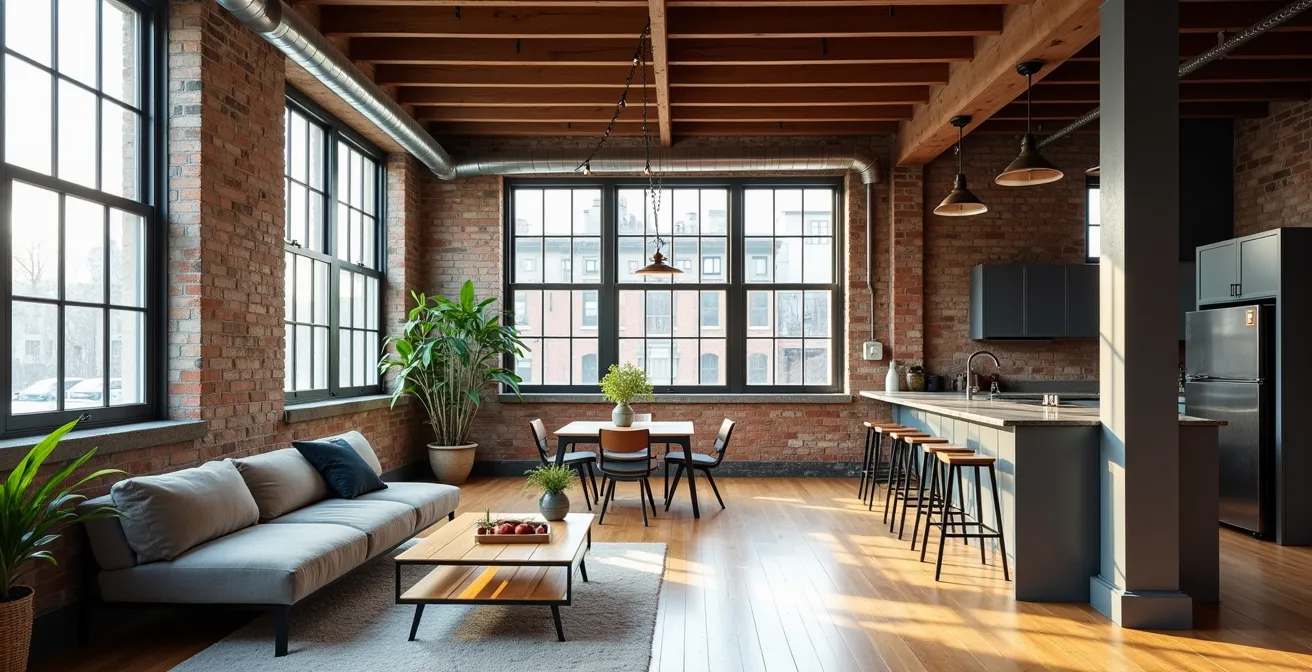
The aesthetic allure of Montreal’s industrial lofts often conceals significant structural, financial, and legal liabilities that can turn a dream home into a costly problem.
- Voluminous spaces with poor thermal envelopes can lead to exorbitant heating costs, far exceeding typical residential bills.
- Many “artist studios” exist in a legal grey area, lacking the proper residential zoning required for legal occupancy, posing a risk to owners.
Recommendation: Before falling for the charm of brick and beam, a buyer must adopt an architect’s forensic approach to due diligence, focusing on the building’s performance and legal status, not just its appearance.
The fantasy is a familiar one for anyone who loves Montreal. It’s the morning sun slanting through a massive, steel-framed window, illuminating dust motes dancing over 100-year-old maple floors. It’s the raw texture of exposed brick against minimalist furniture, the soaring 14-foot ceilings, and the view over the Lachine Canal or the rooftops of Mile-Ex. This is the promise of the “hard loft”—a space that feels less like an apartment and more like a piece of the city’s industrial soul. This vision, celebrated in design magazines and blogs, draws in artists, creatives, and professionals who crave authenticity and volume.
But beyond this romanticized surface lies a complex reality governed by physics, municipal bylaws, and the ghosts of past construction standards. While many guides focus on the aesthetic, they often gloss over the inconvenient truths. The conversation tends to stop at “heating can be expensive” or “it might be noisy.” As an architect specializing in the adaptive reuse of these heritage structures, I can tell you that the real issues are far more intricate. The key to a successful loft purchase isn’t just finding a beautiful space; it’s understanding its unseen liabilities.
This guide abandons the platitudes. We will not be admiring brickwork. Instead, we will adopt a forensic approach. The goal is to shift your perspective from that of a romantic buyer to a pragmatic investor, armed with the knowledge to dissect a loft’s true performance. We will analyze the critical factors that separate a well-executed conversion from a financial and legal quagmire. It’s about understanding the thermal envelope, acoustic transmission, and the crucial difference between zoning and a legal right of use. By mastering these concepts, you can make an informed decision, ensuring your industrial dream doesn’t become a nightmare.
To navigate this complex landscape, this article breaks down the essential technical and legal realities you must investigate. The following sections provide a detailed roadmap for your due diligence, covering everything from energy consumption to the building’s legal standing.
Summary: The Unseen Realities of Montreal’s Industrial Loft Conversions
- Why 14-foot ceilings will double your Hydro-Quebec bill in February
- Can you legally sleep there? The risk of living in a purely commercial studio
- The concrete echo: Why industrial floors offer zero sound privacy from neighbors
- The mistake of thinking you can change those drafty industrial windows easily
- Loft vs. Bedroom: Why open concepts are harder to sell to families
- How to test soundproofing in concrete builds before signing the deed
- Pre-delivery inspection: The 3 finishing defects most buyers miss in new units
- Investing in Montreal Plexes: Calculating True ROI Beyond the Listing Price
Why 14-foot ceilings will double your Hydro-Quebec bill in February
The single greatest aesthetic draw of an industrial loft—its vast, open volume—is also its greatest thermodynamic liability. Heat, as physics dictates, rises. In a space with 14-foot ceilings, this means the warmth you pay for congregates uselessly far above your head, while the living area remains chilly. This forces heating systems to work overtime simply to maintain a comfortable temperature at ground level. The result is a staggering consumption of energy, especially during a frigid Montreal February. While a standard apartment’s heating costs are predictable, a loft’s can be shockingly high, a reality many sellers conveniently omit.
To put this in perspective, consider the baseline. A typical Montreal home might have bills ranging from $143 to $181.80 monthly, according to recent Montreal electricity cost analysis. In a poorly insulated loft, this figure can easily double or even triple. The problem isn’t just the ceiling height; it’s the entire thermal envelope. Massive, single-pane industrial windows, uninsulated brick walls, and poorly sealed roof assemblies all act as thermal bridges, bleeding heat directly to the outside. You are essentially trying to heat a beautiful, historic sieve. Before even considering a purchase, demanding to see the last 12 months of Hydro-Quebec bills is not just a suggestion; it’s a critical piece of financial due diligence.
Your Pre-Visit Thermal Envelope Checklist
- Check for drafts around all industrial windows and door frames by hand.
- Ask for the specific R-value (insulation rating) of the roof insulation, which is critical for high ceilings.
- Request the last 12 months of Hydro-Quebec bills from the seller or their agent.
- Verify if a dual-energy system (e.g., gas and electric) is installed, which may grant eligibility for Hydro-Quebec’s preferential Rate DT.
- Inspect exposed brick walls for signs of moisture or crumbling mortar, which can indicate poor sealing.
Ultimately, a loft’s heating bill is a direct measure of its architectural integrity. A low bill suggests a thoughtful, modern conversion with a focus on insulation, while an astronomical one is a red flag for a superficial, aesthetics-only renovation.
Can you legally sleep there? The risk of living in a purely commercial studio
One of the most perilous assumptions a loft buyer can make is that if a space has a kitchen and a bathroom, it’s a legal residence. In Montreal, many buildings, particularly older industrial conversions, are zoned for commercial or artisanal use only. This creates a critical distinction between zoning (what the city permits for a piece of land) and use-right (the legal permission to inhabit a specific unit). You may find “lofts” marketed to artists and creatives that are, in the eyes of the law, nothing more than commercial studios where residential living is explicitly forbidden.
Living in such a unit exposes the owner to significant risks. The municipality could, at any point, enforce the bylaw, potentially leading to eviction orders. Furthermore, standard residential home insurance may be invalid, as the occupancy contravenes the building’s legal designation. Securing a conventional mortgage can also be challenging, as lenders are wary of non-conforming properties. These spaces often exist in a “don’t ask, don’t tell” limbo, which can function for years until a single complaint from a neighbor or a routine inspection brings the entire arrangement crashing down.

A proper conversion involves a formal and costly rezoning process. For instance, the successful transformation of the Viau Ltée cookie factory into residential lofts shows what’s required. This project involved legally changing the building’s designation to residential, ensuring every unit complied with the building code for dwellings, including standards for egress, ventilation, and fire separation. When you visit a loft, your first question shouldn’t be about the countertop material; it should be: “Can I see the certificate of location confirming this unit’s legal residential use?”
Case Study: The Viau Cookie Factory – From Industrial to Residential
The conversion of the 1906 Viau Ltée cookie factory into 182 loft-style condos in 2007 is a prime example of a successful and legal adaptive reuse project. The developers undertook the necessary steps to rezone the property from industrial to residential. This ensured that all units, many of which feature closed rooms in addition to open spaces, are fully compliant with residential building codes. The project’s success in a vibrant Montreal neighborhood demonstrates the value of navigating the city’s zoning regulations properly, providing buyers with legally sound and insurable homes.
Without this confirmation, you are not buying a home; you are buying a significant and potentially very expensive legal risk.
The concrete echo: Why industrial floors offer zero sound privacy from neighbors
The thick concrete floors and columns that give lofts their robust, industrial character are exceptionally good at transmitting certain types of sound. While you might think concrete is a great sound blocker, it’s highly effective at conducting impact noise (footsteps, dropped objects, moving furniture) and low-frequency sounds (the bass from a neighbor’s stereo). This phenomenon, known as acoustic transmission, means that you might hear your upstairs neighbor’s every step with startling clarity. Unlike modern wood-frame constructions that use insulation and resilient channels to dampen sound, raw concrete offers no such buffer.
Many of these structures were built over a century ago, long before building codes considered acoustic privacy a priority. The original purpose was to support heavy machinery, not to provide a peaceful living environment. In a poorly executed conversion, nothing is done to mitigate this. The developer simply polishes the original concrete or lays a thin layer of hardwood directly on top, leaving the acoustic transmission path wide open. The result is an “echo chamber” effect, where noise from adjacent units can travel freely through the building’s skeleton.
This lack of acoustic separation becomes a major source of conflict in loft buildings. The open-concept design further exacerbates the problem, as there are no walls or separate rooms to help contain or absorb sound within your own unit. A conversation in the kitchen can feel as loud as one in the sleeping area. Before you buy, it’s crucial to understand that what seems like a solid, quiet building on a Tuesday afternoon could be a very different auditory experience on a Saturday night. The time of day you visit, and the specific tests you perform, are essential to uncovering the building’s true acoustic performance.
Don’t just look at the floors; listen to them. A building’s acoustic signature is a permanent feature, and no amount of interior design can fix a fundamental flaw in its construction.
The mistake of thinking you can change those drafty industrial windows easily
Those magnificent, oversized industrial windows are often the centerpiece of a loft’s appeal. They are also frequently its weakest point, being old, single-paned, and thermally inefficient. A common assumption is that they can be replaced like any other window. This is a costly and often false assumption. Many of these loft conversions are in designated heritage buildings, which means any exterior modification, especially window replacement, is subject to strict municipal regulations and a heritage mandate. You cannot simply install a standard, energy-efficient vinyl window.
Instead, the city often requires that you replace the window with a custom-made replica that matches the original’s historical appearance, materials, and dimensions. This could mean commissioning windows with custom-milled wood frames or specialized steel frames, which are exponentially more expensive than off-the-shelf solutions. The cost difference is not trivial; we’re talking about a 5x to 15x price multiplier compared to a standard residential window replacement. What might cost $1,000 in a typical condo could easily cost $8,000 to $12,000 per window in a heritage loft.
This is a major capital expenditure that many buyers fail to budget for. Before purchasing, it is absolutely essential to check the building’s heritage status and review the condominium syndicate’s bylaws regarding exterior modifications. The following table illustrates the dramatic cost differential you may face. As this comparative cost analysis for Montreal heritage buildings shows, the price of preserving history is steep.
| Window Type | Standard Replacement | Heritage-Approved | Price Multiplier |
|---|---|---|---|
| Vinyl Double-Pane | $800-1,200 | Not Permitted | N/A |
| Custom Wood Replica | N/A | $4,000-8,000 | 5-10x |
| Steel Frame Historic | N/A | $6,000-12,000 | 7-15x |
Those beautiful windows might be the most expensive feature of the entire property in the long run. Do not underestimate this cost.
Loft vs. Bedroom: Why open concepts are harder to sell to families
The open-concept layout is the philosophical heart of loft living. It promotes a sense of freedom, fluidity, and uninterrupted space. For a single person or a couple, this is often ideal. However, this very openness can become a major liability when it comes to resale value. The real estate market is diverse, and by design, a true “hard loft” with no closed bedrooms excludes a significant portion of potential buyers: families, roommates, or anyone needing privacy for a home office.
This lack of “spatial liquidity”—the ability for a space to adapt to different life stages and needs—can significantly prolong the time a property sits on the market. While your artistic sensibilities may appreciate a single, 1,200-square-foot room, a family with a young child sees an unworkable living arrangement. A professional working from home sees a space with no acoustic separation from the rest of the household. As a seller, you are waiting for a buyer whose lifestyle perfectly matches the unit’s inflexible layout, shrinking your potential market considerably.
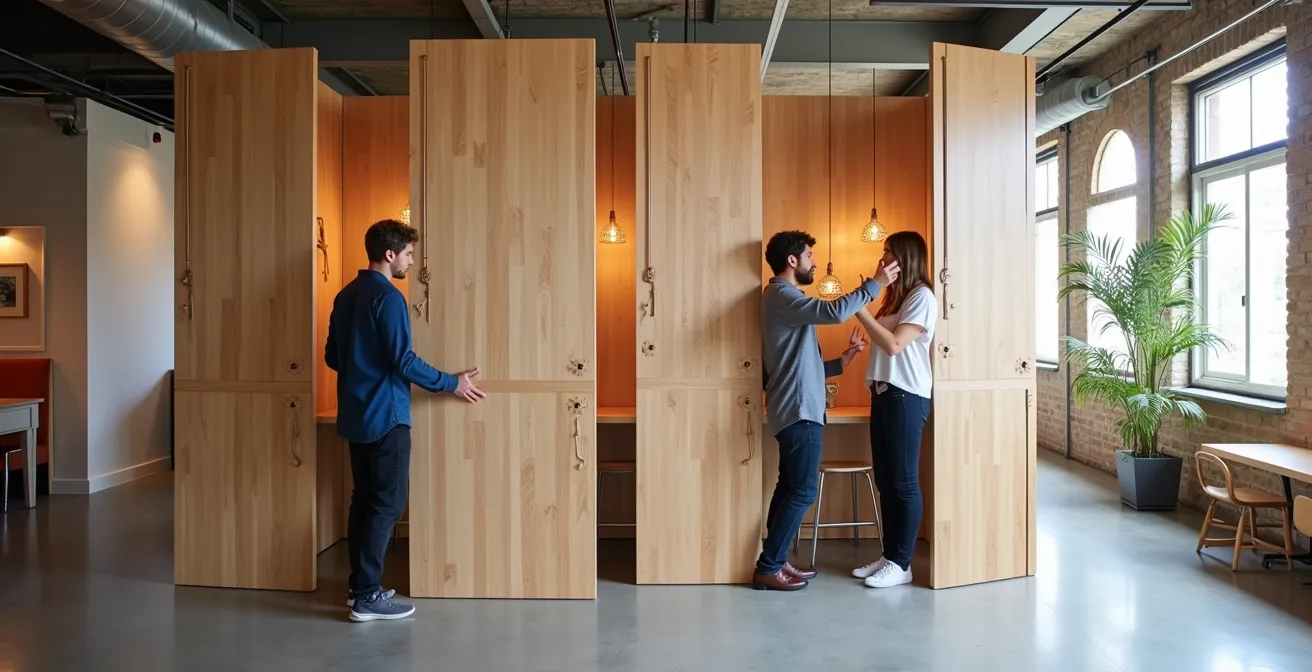
Some loft owners attempt to mitigate this by erecting new walls, but this is often a clumsy and expensive solution that compromises the very aesthetic that made the loft desirable in the first place. These additions can feel like an afterthought, disrupting the flow of light and the sense of volume. A more elegant solution involves using modular, non-permanent dividers that can create zones without sacrificing the open feel. However, the most marketable (and valuable) lofts are often those that were designed from the start with a “soft loft” approach: maintaining a large, open primary living area but including at least one fully enclosed bedroom. This hybrid model offers the best of both worlds: the loft aesthetic with the practicality required by a broader range of buyers.
When you buy a loft, you are not just buying a home for today; you are buying a financial asset that you will one day need to sell. A lack of bedrooms is a lack of future buyers.
How to test soundproofing in concrete builds before signing the deed
Given that concrete is an excellent conductor of impact and low-frequency noise, a visual inspection of a loft is acoustically useless. You must conduct a series of practical tests to understand the reality of the acoustic transmission between units. This is a crucial part of your due diligence, as retrofitting soundproofing into a concrete structure is prohibitively expensive and often ineffective. Your goal is to simulate the conditions of everyday life and uncover any potential noise issues before they become your daily reality. This requires a bit of audacity and the seller’s cooperation, but it is non-negotiable.
Many of these Montreal loft conversions involve 19th-century industrial buildings, constructed with materials and methods that prioritized structural strength over acoustic comfort. The Quebec Construction Code has evolved significantly, with modern standards demanding much higher levels of sound insulation between dwellings. A key piece of information is determining whether the conversion was completed before or after the implementation of these stricter codes. An older conversion is far more likely to have significant acoustic flaws. Don’t be shy about asking direct questions and performing tests; you are making one of the largest financial decisions of your life.
Action Plan: Your Acoustic Due Diligence Protocol
- The Time-of-Day Test: Schedule a second visit during peak activity hours (e.g., a weeknight between 6 PM and 8 PM) when neighbors are home and likely to be making noise.
- The Impact Noise Test: With permission, ask the seller or agent to go to the unit above and walk heavily, bounce a small ball, or drop a book. Listen carefully from the unit you are considering.
- The Polite Neighbour Test: If possible, knock on the doors of adjacent units (above, below, and beside). Introduce yourself as a prospective buyer and politely ask about their experience with noise in the building.
- The Documentation Test: Request the last two years of the condo syndicate’s meeting minutes. Read them carefully, looking for any recurring noise complaints, which are a major red flag.
- The Building History Test: Ask the agent for the date the conversion was completed and verify if it predates the current, more stringent Quebec Construction Code requirements for sound insulation.
Remember, you can change a loft’s paint color, but you cannot change its structural sound transmission. What you hear during your inspection is what you will live with for years to come.
Pre-delivery inspection: The 3 finishing defects most buyers miss in new units
In the excitement of a pre-delivery inspection (PDI), particularly in a visually stunning space like a newly converted loft, buyers are often so captivated by the grand features—the high ceilings, the brick walls—that they overlook critical finishing details. As an architect, I’ve seen that it’s often the small, subtle defects that signal larger, underlying problems with the quality of the conversion. These are not just cosmetic issues; they can be expensive to fix and can affect the long-term enjoyment and value of your property. Buyers, especially those new to this type of real estate, tend to miss the same crucial points.
First is the uneven floor leveling. Old industrial buildings often have concrete slabs that have settled over a century. A quality conversion involves pouring a new layer of self-leveling concrete to create a perfectly flat surface before the final flooring is installed. A shortcut is to lay flooring directly on the old, uneven slab. To spot this, get down low and look across the floor towards a light source; dips and waves will be obvious. Roll a marble or small ball across different areas; if it consistently veers or picks up speed in certain spots, the floor is not level.
Second, pay close attention to the integration of modern services. How were the HVAC ducts, electrical conduits, and plumbing lines integrated with the original structure? In a high-end conversion, these are thoughtfully hidden or treated as deliberate, clean design elements. In a rushed job, you’ll see clumsy drywall bulkheads that clash with the ceiling height, or exposed pipes and wires that look like an afterthought rather than an intentional “industrial chic” statement. This signals a lack of design foresight and can be very costly to correct aesthetically. Finally, buyers often miss poor transitions between old and new materials. Examine the joints where new drywall meets 100-year-old brick or concrete. Is the line crisp and perfectly caulked, or is it sloppy, cracked, and filled with grout? A poor joint is not only ugly but can also be a future source of drafts and cracks.
These three areas—floors, services, and joints—are a reliable barometer of the developer’s overall commitment to quality. A failure in these small details often points to bigger problems hidden behind the walls.
Key Takeaways
- The immense volume of a loft is a thermal liability; expect heating costs to be significantly higher than in a conventional apartment. Always demand to see past utility bills.
- Aesthetic appeal does not equal legal residency. Verify the unit’s official residential zoning with the city to avoid purchasing a non-compliant and risky asset.
- Industrial materials like concrete transmit impact noise exceptionally well. The perceived solidity of a loft can mask a severe lack of acoustic privacy from neighbours.
Investing in Montreal Plexes: Calculating True ROI Beyond the Listing Price
After examining the unique and often costly challenges of loft living, it is instructive for any serious investor to contrast this with Montreal’s most traditional and arguably more predictable real estate asset: the plex. While a loft is often a purchase driven by passion and lifestyle, a plex is typically a pragmatic financial instrument. However, just like with lofts, the “true ROI” of a plex is often obscured by hidden costs that go far beyond the listing price and the projected rental income.
One of the great advantages of standard residential buildings in Quebec is energy efficiency. Unlike the cavernous, hard-to-heat volumes of lofts, the smaller, compartmentalized units of a plex are far more economical to run. This is amplified by the fact that Hydro-Quebec’s rates are already highly competitive; a recent comparison showed Montreal as having the lowest residential electricity bills among 21 major North American cities. This inherent efficiency provides a stable and predictable baseline for utility costs, a luxury rarely afforded to a loft owner.
However, the plex is not without its own set of hidden financial traps. The charming brick facades of Plateau or Rosemont buildings require significant capital expenditure over time. Furthermore, Montreal’s Welcome Tax (droit de mutation immobilière) is a significant upfront cost, and annual rent increases are capped by the Tribunal administratif du logement (TAL), which can limit your ROI compared to market-rate appreciation. A savvy investor must calculate their true return by factoring in these inevitable, long-term capital costs.
| Cost Category | Frequency | Estimated Cost | Impact on ROI |
|---|---|---|---|
| Brick Repointing | Every 15-25 years | $15,000-30,000 | -0.5% annually |
| Foundation Work (clay soil) | As needed | $20,000-50,000 | -1% if required |
| Welcome Tax (Montreal) | At purchase | Progressive brackets | -2-3% upfront |
| TAL Rent Increases | Annual limit | Capped percentage | -0.3% vs market |
Whether the poetic challenges of a loft or the pragmatic returns of a plex are right for you, the governing principle remains the same: a successful investment is one where you have accounted for all costs, not just the visible ones.