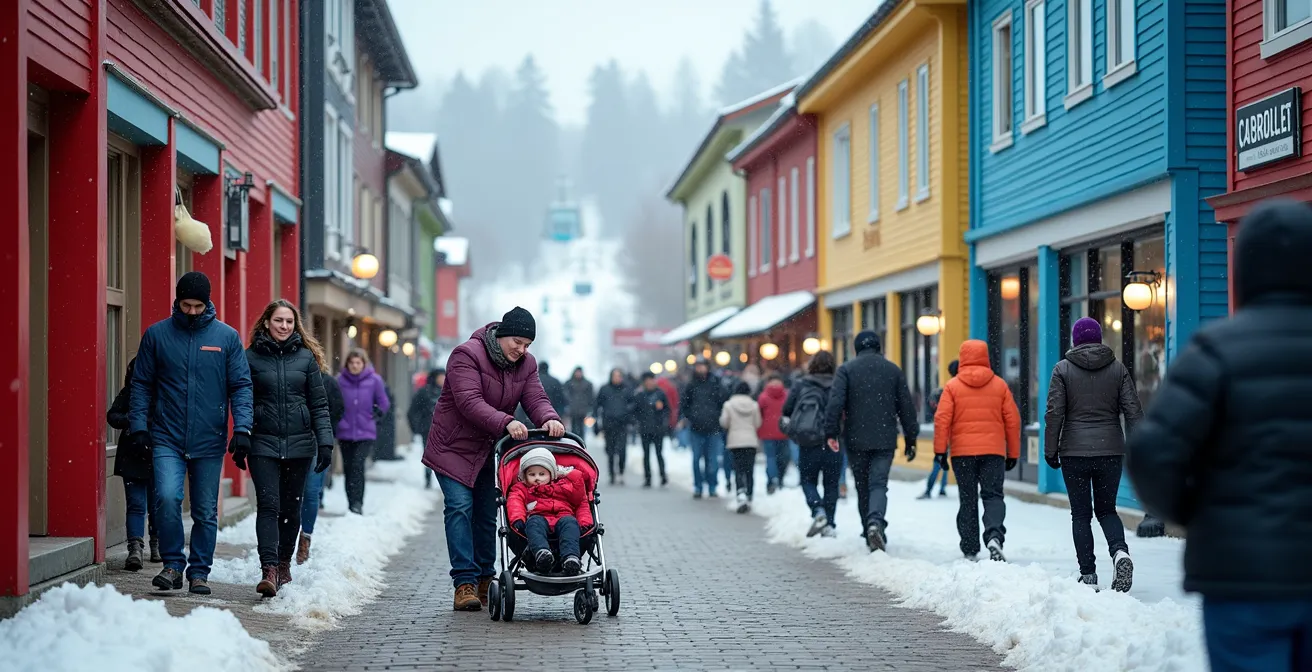
The secret to a successful Mont-Tremblant family trip isn’t which activities you choose, but mastering the logistical game of the ‘in-between’ moments.
- Prioritize paid parking to drastically reduce the “schlep factor” of carrying gear and tired children.
- Ditch the city stroller for a traditional Quebec *traîneau* (sled) to glide over snow and cobblestones.
- Avoid peak crowds by timing your gondola rides before 9:00 AM and planning around major school breaks.
Recommendation: Shift your mindset from ‘vacationer’ to ‘logistical expert’. Every choice that saves your family’s energy—even if it costs a few dollars—is a winning move.
The mental image of a family ski trip to Mont-Tremblant is always pristine: sparkling snow, laughing children, and cozy moments by the fire. The reality, as any parent knows, often begins with the logistical Tetris of packing the car and the looming dread of the “schlep”—hauling skis, bags, and a toddler who has suddenly lost the ability to walk. Most travel guides will tell you about the best ski runs or the most popular restaurants. They’ll praise the car-free pedestrian village as a haven of safety for little ones, and they’re not wrong. But they rarely talk about the physics of that village: it’s built on a hill.
This is where most family trips hit their first point of “logistical friction.” The beautiful, safe, car-free village becomes a gauntlet of gear-hauling, stroller-wrangling, and crowd-dodging. But what if the key to a genuinely relaxing trip wasn’t found in a brochure, but in a tactical playbook? What if you could outsmart the crowds, eliminate the schlepping, and navigate the resort like a seasoned local who has done this twenty times before? That’s precisely the goal here. Forget the generic advice. This is your sherpa’s guide to conquering the mountain’s logistics, so you can focus on making memories, not managing meltdowns.
This guide provides a tactical plan, addressing the real-world challenges families face. We’ll cover everything from the crucial first decision in the parking lot to finding a clean washroom in a pinch, ensuring your energy is spent on the slopes, not on logistical hurdles.
Summary: A Tactical Playbook for Families at Mont-Tremblant
- Why the VIP parking is worth the $20 when you have toddlers and ski gear
- Cabriolet or Walking: How to move a stroller up the village elevation?
- BeaverTails or Sit-down: Where to feed 4 kids under $60 in the village?
- The mistake of joining the gondola line at 10:Departing Gaspésie Harbors: Choosing the Right Whale-Watching Cruise for Your Motion Sickness
- Where to find clean public washrooms near the base without entering a restaurant
- Ski-in/Ski-out vs. “Minutes away”: Decoding misleading proximity descriptions
- The “last mile” reality: When the listing says 4×4 required, do they mean it?
- Renting a Sugar Shack Cottage: Experience the Maple Season Like a Local Producer
Why the VIP parking is worth the $20 when you have toddlers and ski gear
Your first decision at Tremblant sets the tone for the entire day, and it happens before you even see the slopes. You’ll be tempted by the signs for free parking at lots P1 and P2. Resist this temptation. For a family with young kids and a mountain of gear, this is a classic rookie mistake. What isn’t advertised is the 10-15 minute uphill walk from those lots to the base of the village, often through slush or over ice. Now, imagine doing that walk carrying skis, poles, bags, and possibly a tired toddler. It’s a recipe for parental frustration before your day has even begun.
This is where a concept I call “Energy Arbitrage” comes in. Paying the $20-$30 for the VIP lot isn’t a luxury; it’s a strategic investment in your family’s stamina and sanity. Detailed forum analyses from seasoned visitors show the VIP lot is a mere 2-minute walk to the Cabriolet gondola. That’s not just a time-saver; it’s a trip-saver. It turns your car into a functional “Parenting Basecamp.” Forgot the spare mittens? Need to grab a snack? It’s a quick, painless trip back, not a 30-minute expedition. Parents consistently report that the fee is negligible compared to the value of avoiding meltdowns and preserving energy for the actual skiing.
Here is a simple timeline to maximize your parking strategy:
- Arrive Early: On peak weekends, aim to arrive before 8:30 AM to guarantee a spot in the VIP lot.
- Use the Drop-Off Zone: If you’re staying in the village, use your hotel’s drop-off zone first. One parent unloads the kids and the bulk of the gear while the other parks the car. This divides the labor and minimizes chaos.
- Look for Free Weekdays: During the week (Monday-Thursday), the attendant booth for the VIP lot is often unmanned, making it free. It’s a small win that feels great.
- Afternoon Arrival Plan: If you arrive later in the day, check the P3 and P4 lots first; they are closer than the main P1/P2 lots and can save you some walking.
Think of that parking fee as the best money you’ll spend all day. It buys you patience, energy, and a smoother start to your adventure, which is priceless when managing the unpredictable moods of small children.
Cabriolet or Walking: How to move a stroller up the village elevation?
Many parents wonder if Mont-Tremblant is stroller-friendly in winter. The short answer is no, not if you bring your standard city stroller. The combination of cobblestone paths, steep inclines, and persistent snow or ice makes pushing a typical stroller with small wheels an exercise in futility. You will see many exhausted parents struggling, and you don’t have to be one of them. The free Cabriolet lift is your best friend for vertical transport, but you still need to navigate the village itself. The real “sherpa” move is to leave the stroller at home entirely.
Instead, embrace a true Quebec winter tradition: the traîneau. A simple utility sled, available at any Canadian Tire, is the single best tool for transporting a small child and their gear around the village. It glides effortlessly over snow and is surprisingly manageable on cleared paths. It turns the “schlep” into a fun ride for your toddler and a far easier pull for you. This simple switch in equipment is a game-changer that most out-of-province visitors overlook.
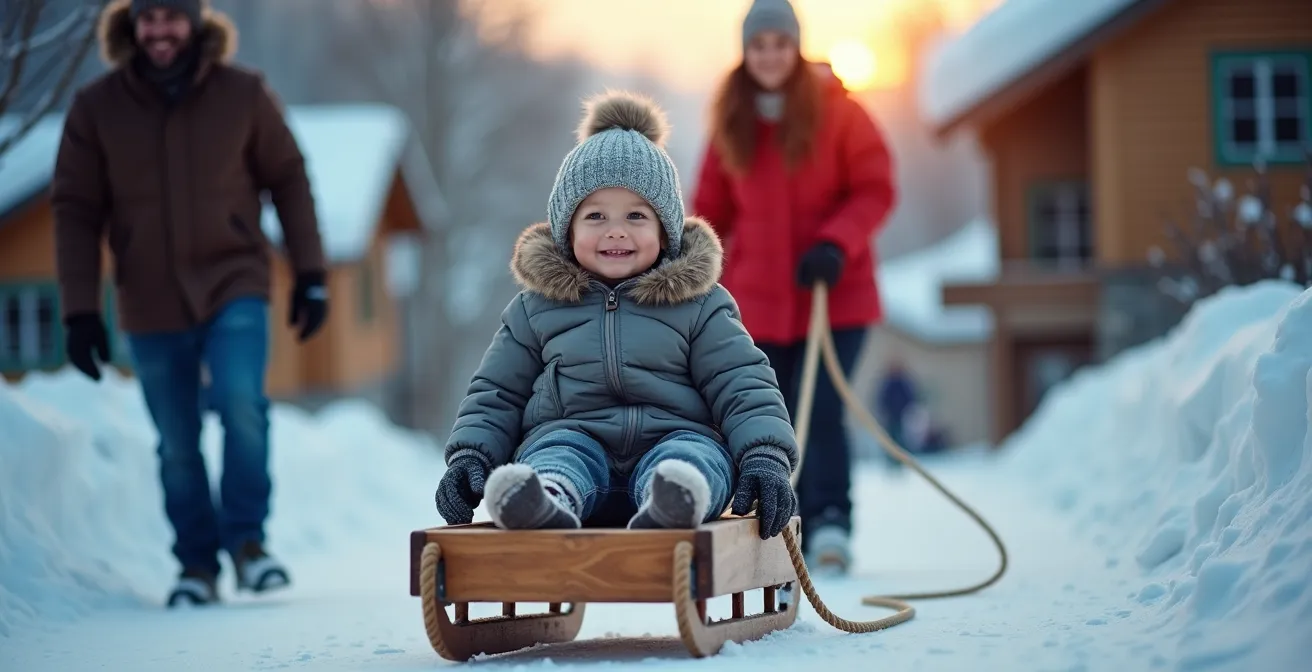
As the image beautifully illustrates, the traîneau isn’t just practical; it’s part of the authentic local experience. Beyond the sled, you have other smart options to consider:
- Rent for the Conditions: The resort’s rental service offers “big-wheeled” winter strollers designed for the terrain. This is a good option if you need the structure of a stroller.
- Carry the Kid: For younger children, renting a kid-carrying backpack from a service like Babyrendezvous.com at the village base is an excellent, hands-free solution.
- Stick to Main Paths: If you must use a stroller, stay on the main central walkways. They are wider, flatter, and generally better cleared than the smaller, winding side paths.
- Cabriolet is Key: For moving between the lower and upper village, always use the Cabriolet. It’s free, fits a sled or folded stroller, and saves you from a steep, tiring push.
By ditching the frustrating stroller and adopting a local solution like the traîneau, you not only solve a major logistical headache but also give your child a more memorable and enjoyable way to experience the winter wonderland.
BeaverTails or Sit-down: Where to feed 4 kids under $60 in the village?
Feeding a family in a resort village can quickly decimate your daily budget. While the allure of a cozy, sit-down restaurant is strong, a meal for four can easily surpass $100-$150. Even a round of iconic BeaverTails pastries, while delicious, isn’t a sustainable meal plan. The “sherpa” parent knows that the secret to affordable eating at Tremblant lies in a hybrid approach: combining strategic grocery shopping with quick-service treats.
The most effective strategy is to make a grocery run in the town of Mont-Tremblant (formerly Saint-Jovite), a 10-minute drive from the resort, before you even check into your accommodation. Stores like IGA or Metro offer everything you need for breakfasts, packable lunches, and simple dinners if you’re staying in a condo with a kitchenette. This single stop can cut your daily food costs by more than half.
The Saint-Jovite Grocery Strategy
One family of six reported on their strategy of stocking up at the IGA in Saint-Jovite. By purchasing Quebecois staples like tourtière (meat pie), local cheeses, and breakfast items, they were able to feed their entire family for under $60 per day for their main meals. This allowed them to splurge on occasional village treats like hot chocolate and BeaverTails without breaking the bank, keeping their overall food budget far below what on-resort dining would have cost.
For those times you need a quick and relatively affordable meal right in the village, this comparative analysis, based on data from family travel blogs like Wandering Wagars’ guide to Tremblant with kids, can help you decide.
| Option | Cost for Family of 4 | Location | Best For |
|---|---|---|---|
| Smoke’s Poutinerie | $35-45 | Pedestrian Village | Shareable family-size poutine |
| IGA Saint-Jovite | $30-40 | 10 min drive | Groceries for condo meals |
| Village SAQ + Dépanneur | $40-50 | In village | Après-ski snacks at condo |
| Picnic at Chapel benches | $20-30 | Near Saint-Bernard | Packed lunch with view |
By planning ahead and treating village restaurants as an occasional treat rather than a daily necessity, you can enjoy all the flavours of Tremblant without the financial stress.
The mistake of joining the gondola line at 10 AM
There’s a predictable rhythm to the crowds at Mont-Tremblant, and the main gondola is its pulse. The biggest mistake a family can make is to casually wander over to the gondola line at 10:00 AM. This is precisely when the ski school lessons are starting and the day-trippers have finally made their way up from the parking lots. The result is a massive bottleneck and potential wait times of 30-45 minutes—an eternity for an impatient child in ski boots.
The “sherpa” strategy is to operate on the edges of this rush hour. Your goal is to be on one of the first gondolas of the day. This means being in line by 8:15 AM. You’ll be rewarded with empty slopes, crisp corduroy, and the feeling of having the mountain to yourself. First-timer reports confirm that the gondola operates continuously from 8:30 AM, but there is a significant surge starting around 9:30 AM that lasts for over an hour. Getting ahead of it is a massive strategic win.
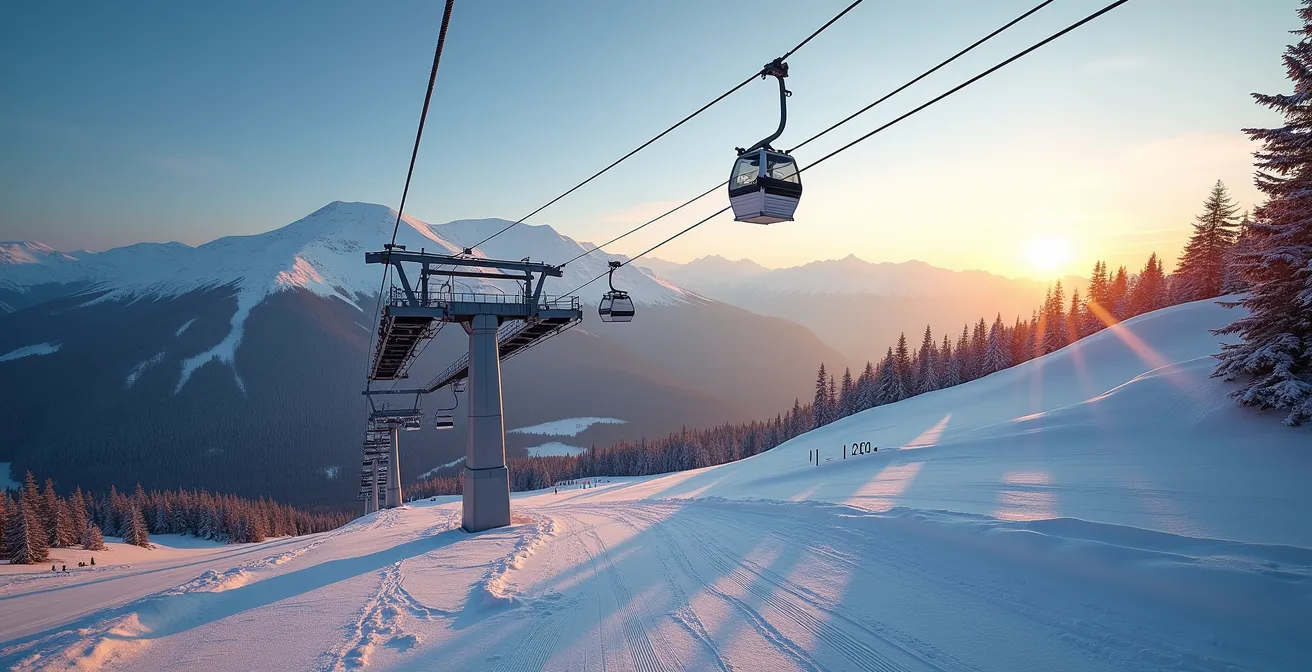
As this serene view shows, the reward for an early start is tranquility and efficiency. An equally valid strategy is the late-afternoon approach. The crowds thin out considerably after 2:30 PM, making it a great time for a few relaxed final runs. To truly master crowd avoidance, you must be aware of the Quebec and Ontario holiday schedules, which create surges far beyond a typical weekend.
- Avoid: Quebec’s *semaines de relâche*. These two separate March break weeks see the resort at absolute peak capacity with families.
- Avoid: Ontario Family Day Weekend. This February holiday brings a massive influx of day-trippers and weekenders from the Toronto area.
- Avoid: December 26 – January 2. The time between Christmas and New Year’s is the busiest period of the entire year.
- The Sweet Spot: The best time for minimal crowds is consistently Tuesday through Thursday mornings, before 8:30 AM.
By treating the gondola schedule like a flight departure, you can avoid the biggest crowds and maximize your precious, and expensive, time on the snow.
Where to find clean public washrooms near the base without entering a restaurant
When a small child declares a “potty emergency,” the nearest washroom becomes the most important landmark in the entire resort. The default parent instinct is to duck into the closest restaurant, but this can be awkward and isn’t always welcomed. Knowing the locations of clean, accessible public washrooms is a piece of tactical knowledge that provides incredible peace of mind. It’s a map every parent should have memorized.
The key is to know where the semi-hidden, cleaner, and less-crowded options are. While there are a few obvious public facilities, they are often busy and not always in the best condition during peak hours. Furthermore, your options can be limited during the shoulder seasons. The official Tremblant facilities guide confirms that only 3 of the 7 public washroom locations may remain open in the spring and fall, making your secret spots even more valuable. You need a reliable plan.
Your Essential Tremblant Washroom Map
- Chalet des Voyageurs: Located at the very base of the village, this is the main public hub. It has changing tables but is predictably the busiest, especially from 11 AM to 2 PM. Use it, but have backups.
- Sommet des Neiges Hotel Lobby: Your best-kept secret. Walk into the lobby of this high-end hotel as if you belong. The washrooms are on the main floor, are impeccably clean, and have changing tables. This is your go-to for a civilized break.
- Main Ticket Office (Upper Level): Many people don’t realize there are washrooms on the upper floor of the main ticket building (where you buy lift passes). They are far less crowded than the ones at the base.
- Near the Cabriolet Station: There is a small but strategically located washroom building near the base of the Cabriolet lift. It’s perfect for a last-minute stop before heading up the village.
- The Emergency Phrase: If all else fails, confidently walking into any hotel or shop and saying, “Excusez-moi, c’est une urgence pour mon enfant” (Excuse me, it’s an emergency for my child) works almost every time in Quebec.
This isn’t just about convenience; it’s about control. Having a mental map of these locations means you can explore the village with confidence, knowing you’re always just a few steps away from a clean and accessible solution.
Ski-in/Ski-out vs. “Minutes away”: Decoding misleading proximity descriptions
When booking accommodation, no terms are more alluring—or more misleading—than “ski-in/ski-out” and “slopeside.” For a family, the promise of stepping out the door and onto the snow is the ultimate dream. However, the reality at Tremblant, as at many resorts, can be very different. These terms are used loosely, and not understanding the fine print can lead to a daily logistical nightmare of stair-climbing and gear-hauling.
True ski-in/ski-out means you can ski directly to and from your door with no walking or stairs. At Tremblant, properties like Place St-Bernard offer this genuine experience, with rooms directly overlooking the main base. However, many properties marketed as ski-in/ski-out, particularly in the Domaine de la Forêt area, might require you to navigate several flights of outdoor, often icy, stairs to reach a trail. Experienced families have noted that a ground-floor, “niveau-jardin” unit that’s slightly farther away is often far more practical for managing gear and tired kids than a “closer” third-floor unit with multiple staircases.
To avoid disappointment, you need a realistic mental model for what these marketing terms actually mean in terms of time and effort with a family. A recent analysis from the official Tremblant blog provides the basis for a more honest calculation.
| Marketing Term | Actual Time | With Kids Factor | True Total |
|---|---|---|---|
| ‘Ski-in/Ski-out’ | 0-2 min | +5 min gear | 5-7 min |
| ‘Slopeside’ | 3-5 min | +10 min stairs/gear | 13-15 min |
| ‘Minutes away’ | 5-10 min | +15 min shuttle wait | 20-25 min |
| ‘Short shuttle ride’ | 10-15 min | +20 min peak waits | 30-35 min |
Before booking, use Google Maps’ satellite and street view to physically inspect the path from the property to the slope. Look for stairs, steep paths, and road crossings. A few minutes of digital scouting can save you hours of physical frustration on your trip.
The “last mile” reality: When the listing says 4×4 required, do they mean it?
When you’re renting a chalet or cottage just outside the main resort, you’ll often see a small note in the listing: “4×4 or AWD recommended in winter.” Let me be clear: this is not a suggestion. It is a requirement. The “last mile” to many of Quebec’s most beautiful rental properties involves steep, winding, and privately maintained roads that can become treacherous sheets of ice. Believing your front-wheel-drive car with all-seasons will make it is a gamble that can leave you stranded and waiting for a tow truck.
Beyond the vehicle itself, there’s a non-negotiable legal and safety requirement: proper winter tires. It’s not just a good idea; it’s the law. Quebec’s official traffic regulations mandate that all passenger vehicles be equipped with certified winter tires from December 1 to March 15. The law is strictly enforced, with fines ranging from $200-$300. These tires, marked with a mountain and snowflake symbol, are made of a softer rubber compound that stays flexible in the cold, providing critical traction that all-season tires simply cannot match.
Even with the right vehicle and tires, you should be a proactive consumer. Arm yourself with specific questions for the rental host to gauge the true accessibility of their property during a snowstorm. A responsible host will have clear answers.
- “What is the grade percentage of your driveway?” (Anything over 15% is extremely challenging in ice.)
- “Who plows the private road and your driveway, and how often during a storm?”
- “Have any guests with AWD vehicles ever needed towing?” (The answer is very revealing.)
- “Is there a designated turnaround spot at the bottom if we can’t make it up?”
- “Your road is listed as a *’chemin privé non entretenu’*. What does that mean for winter plowing and sanding?”
Renting from Toronto or the US? If your rental car doesn’t come with winter tires, you are legally and practically unprepared. Confirm with the rental agency beforehand or be prepared to change your plans. Your vacation starts with arriving safely, not with a stressful call for a tow.
Key Takeaways
- The small premium for VIP parking is a strategic investment in your family’s energy and sanity.
- Ditch the city stroller; a traditional Quebec sled (*traîneau*) is the superior tool for navigating the village with a toddler.
- Mastering the resort’s rhythms—like avoiding the 10 AM gondola rush—is more valuable than any lift ticket discount.
Renting a Sugar Shack Cottage: Experience the Maple Season Like a Local Producer
Here is the ultimate “sherpa” move: consider skipping the peak ski season chaos altogether. If your schedule is flexible, planning a trip for March or early April allows you to experience a side of Quebec culture that is arguably more authentic and memorable than the ski slopes: maple season. As the spring break crowds thin out, the region’s hundreds of *érablières* (maple groves) come to life. Renting a cottage near a working *cabane à sucre* (sugar shack) offers a completely different, and often more relaxing, family vacation.
This is the season of *la saison de la boue* (mud season), but with the right gear, it’s magical. Families who have tried this alternative report a more immersive cultural experience. Instead of waiting in lift lines, you’re hiking through maple forests, watching sap being collected, and learning how it’s boiled into syrup. The highlight for any child is making *tire d’érable*—hot, fresh maple taffy rolled onto clean snow. It’s a hands-on, delicious experience that connects them directly to the land and its traditions.
To fully embrace this unique season, your packing list needs to be adjusted. Forget the high-tech ski gear and focus on practical, waterproof essentials.
- Waterproof Boots: This is non-negotiable. Look for boots rated for both slush and mud.
- Layered Clothing: March weather in Quebec can swing 10 degrees Celsius in a single day. Pack layers you can add or remove easily.
- A Large Pot: If your cottage rental is on a property that taps its own trees, they may offer you fresh sap. Bringing a large pot to boil it down yourself is an unforgettable chemistry lesson.
- Plastic Sheets: For making your own maple taffy on the snow on your balcony or yard.
- A French Phrasebook: Learn a few key maple-related terms like *acériculteur* (maple producer) and *sirop d’érable* (maple syrup). Your effort will be warmly appreciated.
For a truly memorable family trip, consider trading the adrenaline of the slopes for the sweet, slow rhythm of the sugar shack. You’ll leave with a deeper appreciation for Quebec’s culture and a year’s supply of the world’s best maple syrup.