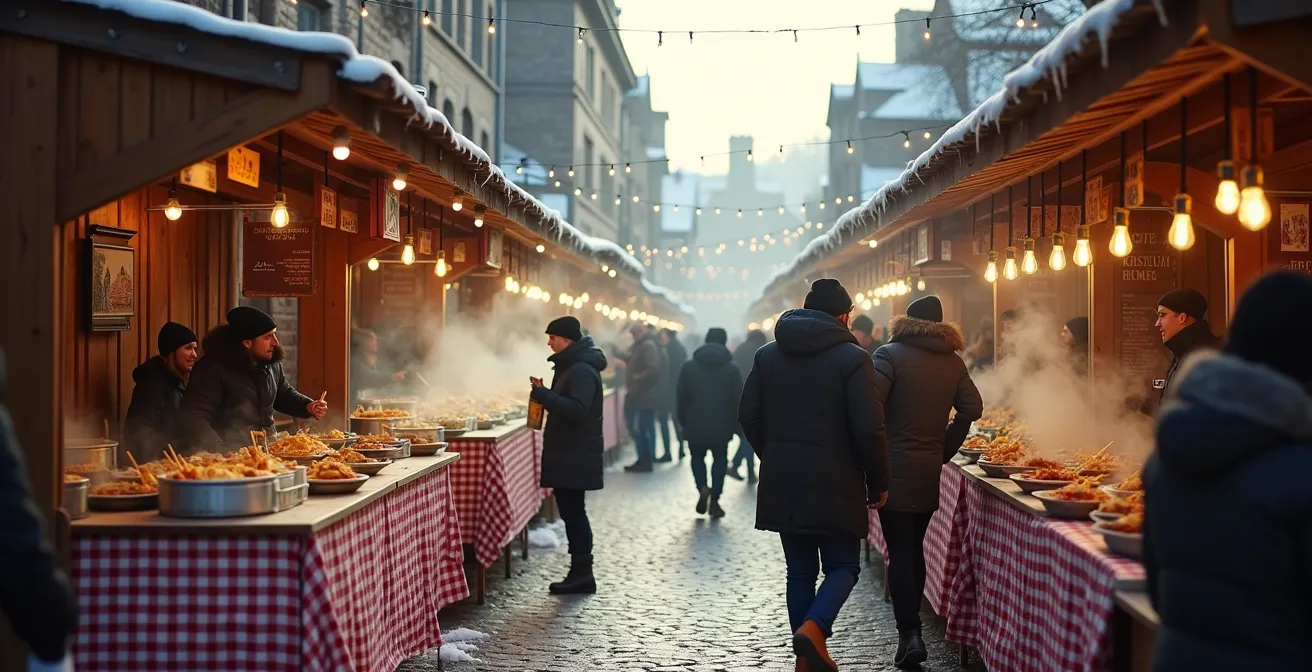
The key to unlocking Quebec’s authentic food scene isn’t just what you eat, but how you strategically navigate its festivals.
- Uncover deep regional rivalries, like the intense debate between Cipaille and Tourtière du Lac, to taste the province’s true culinary diversity.
- Master seasonal eating by timing your visit for the apex of harvest festivals, from Île d’Orléans strawberries to autumn corn roasts.
Recommendation: Shift from a tourist’s checklist to a local’s mindset. Plan your next journey around a specific product, a regional route like the Route des Saveurs, or a seasonal festival to experience the true depth of Quebec’s terroir.
To the uninitiated, Quebec’s culinary landscape appears to be a simple trinity: poutine, tourtière, and maple syrup. These are the headliners, the icons plastered on tourist menus from Old Montreal to the Chateau Frontenac. While undeniably delicious, they represent only the first page of a gastronomic encyclopedia rich with regional conflict, seasonal rites, and unwritten rules. Many guides will list the famous festivals, but they fail to equip you with the essential strategy required to navigate them like a seasoned local, not a wide-eyed visitor.
The real story of Quebec food is told not in restaurants, but in the bustling, temporary villages of its food festivals. It’s found in the steam rising from a sugar shack, the fierce pride of a Saguenay cook defending their pie recipe, and the savvy deployment of sampling tickets at a food truck rally. To focus only on the famous dishes is to see the Eiffel Tower but miss the Parisian cafés, the street markets, and the neighbourhood bistros where the city’s heart truly beats.
This guide breaks from that tradition. We will move beyond the checklist of what to eat and delve into the more sophisticated art of *how* to eat. Forget just tasting poutine; we will explore the culinary civil war between different regional meat pies. Instead of just acknowledging maple, we will decode the seasonal calendar that dictates when and where to find the absolute peak of flavour for everything from wild blueberries to fresh corn. This is not a list; it is a strategic playbook for the adventurous foodie.
By understanding the culture, the rivalries, and the logistics, you transform a simple meal into a deep cultural immersion. You will learn to eat more, better, and more authentically, unlocking a side of Quebec’s gastronomy that most travelers completely miss.
This article provides a strategic approach to navigating the province’s rich culinary festival scene. Below is a summary of the key tactics and insights we will cover, from decoding iconic Carnival staples to mastering the logistics of seasonal food tours.
Summary: A Critic’s Guide to Quebec’s Real Gastronomy Festivals
- Caribou and BeaverTails: The history and potency of Carnival staples
- Cipaille vs. Tourtière du Lac: The regional rivalry you taste at festivals
- Sampling tickets vs. Full plates: How to eat more for less at food trucks
- Route des Saveurs: How to link multiple food stops in Charlevoix or Island of Orleans
- Strawberry vs. Corn season: When to hit the rural festivals for peak flavor
- Pea soup to Oreilles de Crisse: A guide to the heavy, caloric traditional meal
- Buying the Effigy: Where to get it cheaper before the event starts
- Surviving the Quebec Winter Carnival with Kids: A Logistics Guide
Caribou and BeaverTails: The history and potency of Carnival staples
The Quebec Winter Carnival is a rite of passage, but its most iconic consumables—Caribou and BeaverTails—are often misunderstood. The BeaverTail (Queue de Castor) is a modern invention, a delicious piece of fried dough created in Ontario in 1978, but wholeheartedly adopted by festival-goers. The true historical artifact is Caribou. This is not the bottled, cloyingly sweet liqueur you find at the SAQ. Authentic Caribou is a potent, warming concoction of red wine, hard liquor (often whisky), and maple syrup, spiced to guard against the biting cold. Its origins trace back to colonial-era trappers and loggers who mixed alcohol with caribou blood for fortification.
Today, the blood is long gone, but the spirit of a powerful, homemade brew remains. The key to an authentic experience is to bypass the commercial versions and seek out those made by local families or sold at smaller, non-profit kiosks during the Carnival. Each family often has its own secret recipe, a closely guarded tradition passed down through generations. To drink real Caribou, served steaming hot, is to taste a piece of Quebec’s rugged history. Finding an authentic version requires a bit of detective work, but it’s a quest that separates the tourist from the true culinary explorer.
Distinguishing the real deal from commercial imitations is a key skill for any Carnival connoisseur. Here are the tell-tale signs of an authentic Caribou:
- It’s often found in homemade batches at family-run stalls or community events, not in branded bottles.
- The recipe foundation is red wine and a strong spirit, balanced with maple syrup and spices like cinnamon or nutmeg.
- It is always served hot, a crucial element for braving the winter temperatures.
- Asking a local about their “family recipe” can often point you toward a more genuine and memorable tasting experience.
Cipaille vs. Tourtière du Lac: The regional rivalry you taste at festivals
While the standard tourtière of ground pork and spices is Quebec’s most famous edible export, it’s merely the opening act. The real drama—and flavour—lies in the province’s deep-seated regional pie rivalries. The most significant of these is the showdown between the Tourtière du Lac-Saint-Jean and the Cipaille of Gaspésie and the Lower St. Lawrence. These are not pies; they are monumental, slow-cooked casseroles that embody the concept of culinary terroir.
Tourtière du Lac is a fortress of a dish. It features a thick, hearty crust containing a dense filling of cubed meats (never ground) like pork, beef, and wild game, layered with potatoes and onions, and slow-cooked for hours until the contents are meltingly tender. It is the undisputed centerpiece of the Réveillon (Christmas Eve feast) in the Saguenay–Lac-Saint-Jean region. Cipaille (sometimes called Six-Pâtes) is its coastal cousin, built on a principle of layering. It involves multiple sheets of pastry layered between different kinds of meat and game, creating a stratified, succulent dish that is equally revered at family gatherings.
To taste one against the other at a regional festival is to understand Quebec on a deeper level. It’s a delicious lesson in how geography, history, and local pride can shape a single culinary concept into wildly different, yet equally beloved, traditions. Forget the generic tourtière; seeking out these regional titans is a mandatory pilgrimage for any serious food traveler.
This table, based on information from culinary explorers, breaks down the key distinctions you’ll find in Quebec’s iconic pies, as detailed in an analysis of regional food variations.
| Region | Pie Type | Key Characteristics | Traditional Occasion |
|---|---|---|---|
| Saguenay-Lac-Saint-Jean | Tourtière du Lac | Cubed (not ground) meats, potatoes, thick crust, hours of cooking | Réveillon (Christmas Eve) |
| Gaspésie/Bas-Saint-Laurent | Cipaille/Six-Pâtes | Multiple layers of pastry, game meat, slow-cooked | Family gatherings |
| Montréal/Outaouais | Standard Tourtière | Ground pork/beef, spiced, single crust | Christmas season |
Sampling tickets vs. Full plates: How to eat more for less at food trucks
Quebec’s food festivals, especially Montreal’s massive First Fridays food truck gathering, can be overwhelming and expensive. The amateur moves from truck to truck, buying full plates and getting full—and broke—after two or three stops. The seasoned festival-goer, however, employs a clear gastronomic strategy. The goal is not to eat one big meal, but to sample as widely as possible. This requires abandoning the “full plate” mindset in favor of a tactical approach focused on value and variety.
The first rule is to look for the hidden gems. Often, the best value and most authentic food comes from kiosks run by non-profit organizations like the Knights of Columbus or the local Cercle des Fermières. These volunteer-run stands prioritize tradition over profit, offering classic dishes at a fraction of the price of trendy food trucks. Secondly, cash is king. Many of these smaller vendors do not accept cards, and having cash on hand is essential. Finally, adopt the “Festival Buddy System.” Instead of each person buying a small sample, two people buy two different full plates and share them. This provides a greater variety and volume of food for the same cost as multiple, smaller portions.
This strategic approach to festival eating is a learned skill. As noted in a guide to Montreal’s food events, planning ahead with festival apps for special deals and arriving early can make a significant difference. It’s about treating the festival grounds like a culinary chessboard, planning your moves to maximize your experience.
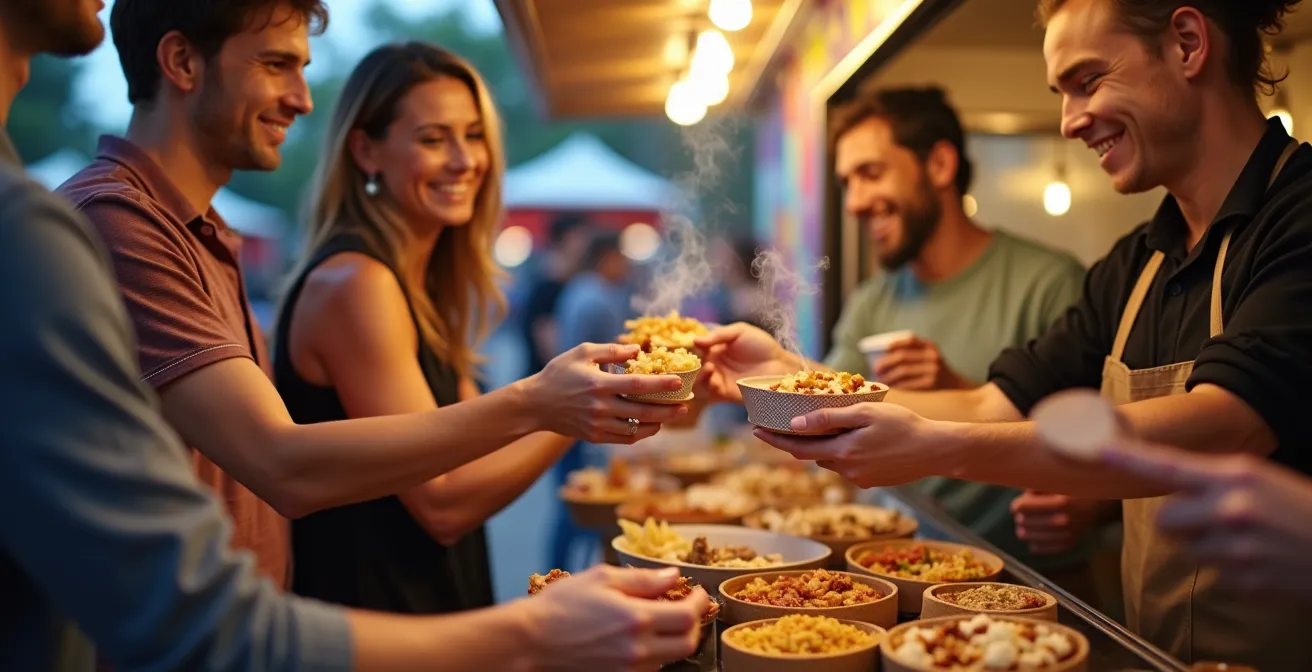
The scene at a bustling food festival is one of shared discovery. As seen here, the interaction at the food truck window is about more than just a transaction; it’s a moment of connection and anticipation. Mastering the logistics allows you to enjoy more of these moments.
Route des Saveurs: How to link multiple food stops in Charlevoix or Island of Orleans
Beyond single-day festivals, the ultimate expression of Quebec’s culinary devotion is the self-guided food tour. Two regions have perfected this art: Charlevoix with its “Route des Saveurs” (Flavour Trail) and the bucolic Île d’Orléans, just minutes from Quebec City. These are not tourist traps; they are curated networks of farmers, cheesemakers, bakers, and cider producers that locals themselves use for their weekly shopping. The strategy here is to think like a Quebecer: this is not a series of attractions, but a grocery run through paradise.
The key is to link multiple stops into a coherent, day-long itinerary. For instance, on Île d’Orléans, a perfect circuit could start at a vineyard for a wine tasting, move to a fromagerie for fresh cheese, stop at a farm stand for strawberries, and end at a chocolatier. The Charlevoix region offers a more expansive trail, winding through picturesque villages to connect duck farms, craft breweries, and producers of the famous Migneron cheese. Quebec’s dominance in agritourism is no accident; the province supplies an impressive 75% of the world’s maple syrup, a testament to its deep connection to the land.
Case Study: The Île d’Orléans Food Circuit
As documented by culinary journalists at 2foodtrippers who experienced a curated tour, a day trip to Île d’Orléans is a masterclass in local sourcing. The journey included stops for famous lobster rolls, organic strawberries directly from Ferme Jean-Pierre Plante, and craft beer tastings at the La Souche microbrewery. This circuit perfectly illustrates how locals transform a simple drive into a comprehensive culinary experience, weaving together multiple artisan producers into a single, delicious narrative. It demonstrates a mindset where the journey itself, from producer to producer, is the destination.
To execute this successfully, you need a car, a cooler bag for your purchases, and an adventurous palate. Forget a rigid schedule; allow for spontaneous stops. The best discoveries are often the small, unadvertised producers you spot on a winding country road. This is the heart of Quebec’s “art de vivre.”
Strawberry vs. Corn season: When to hit the rural festivals for peak flavor
The most sophisticated food travelers know that *when* you visit Quebec is just as important as *where*. The province’s culinary calendar is dictated by the harvest, and the best rural festivals are celebrations of a specific product at its absolute seasonal apex. Showing up in August and expecting the transcendent flavour of June strawberries from Île d’Orléans is a rookie mistake. True gastronomic strategy involves aligning your travel dates with the peak season of the ingredient you wish to celebrate.
The “temps des sucres” (sugar season) in March is the most famous example, when sugar shacks across the province come alive. But the calendar is packed with other, equally essential moments. June belongs to the Fête des Fraises on Île d’Orléans, where the berries are so sweet and fragrant they barely resemble their supermarket counterparts. August is the time for the Festival du Bleuet in Dolbeau-Mistassini, celebrating the tiny, intensely flavoured wild blueberries of the Lac-Saint-Jean region. And late summer brings the beloved tradition of the “épluchette de blé d’Inde” (corn roast), a staple of rural community gatherings.
Planning a trip around one of these harvest festivals offers an experience of unparalleled freshness and authenticity. It’s a chance to taste a product at its perfect moment, surrounded by the community that produces it. As the official tourism board, Bonjour Québec, enthusiastically states, “It’s a year-round food and drink celebration!” This calendar-based approach is the secret to unlocking the most vibrant and memorable flavours the province has to offer.
This harvest calendar, which draws from information compiled by Bonjour Québec’s foodie events guide, is your essential planning tool.
| Month | Product | Flagship Festival | Region |
|---|---|---|---|
| March | Maple Syrup | Temps des sucres (Sugar Season) | Province-wide sugar shacks |
| June | Strawberries | Fête des Fraises | Île d’Orléans |
| August | Wild Blueberries | Festival du Bleuet | Dolbeau-Mistassini |
| August-September | Corn | Épluchette de blé d’Inde | Rural communities |
| September | Apples | Festival de la Pomme | Various regions |
Pea soup to Oreilles de Crisse: A guide to the heavy, caloric traditional meal
The traditional Quebec meal, often served at sugar shacks or family gatherings, is a formidable, calorie-laden affair designed to fuel workers through harsh winters. It’s a multi-course marathon that typically includes soupe aux pois (pea soup), cretons (pork pâté), fèves au lard (beans with pork fat), and often culminates in oreilles de crisse (“Christ’s ears”)—deep-fried salt pork rinds. This is historical, hearty, and heavy cuisine. While deeply authentic, it can be a shock to the modern palate. The strategy for approaching this meal is two-fold: understanding its evolution and mastering the art of the digestif.
First, it’s crucial to recognize that Quebec cuisine is not static. A “Nouvelle Cuisine du Terroir” movement, spearheaded by chefs like Normand Laprise of Toqué!, has been working for decades to refine and elevate these classic dishes. As Chef Laprise notes, “Today, the produce comes from here, the chefs come from here and the culture is coming from here. But we are still connected with classic dishes such as tourtière or pea soup.” These chefs honour the traditional flavours while introducing modern techniques and a lighter touch, offering a bridge between the past and present.
Second, for the traditional experience, the local solution to such a heavy meal is the strategic use of digestifs. Quebec produces a remarkable array of spirits perfect for the task. A shot of Sortilège (maple whisky) after tourtière, a glass of cidre de glace (ice cider) to cut through the richness of pea soup, or a local fruit-based eau-de-vie are not just drinks; they are essential digestive tools. Embracing the local digestif culture is key to enjoying—and surviving—the traditional Quebecois feast.
Action plan: Auditing a traditional meal for the modern palate
- Identify the core components: List every dish in the traditional meal, from the soupe aux pois to the oreilles de crisse.
- Assess the ‘heaviness’ factor: For each dish, note the primary ingredients (pork fat, pastry, sugar) to understand its caloric density.
- Research modern interpretations: Look for how contemporary Quebec chefs (like Normand Laprise’s school of thought) deconstruct or lighten these same dishes.
- Select a strategic digestif: Based on the meal’s profile, choose a complementary local spirit (ice cider for richness, maple whisky for spice) to aid digestion.
- Create a tasting plan: Decide whether to sample small portions of everything or focus on one or two classic dishes paired with a modern counterpart to appreciate the evolution.
Key Takeaways
- True Quebec gastronomy lies in regional specialties and seasonal eating, far beyond the well-known poutine and tourtière.
- A strategic approach is essential: learn the local tactics for navigating festivals, from using sampling tickets to understanding regional pie rivalries.
- Timing is paramount. Aligning your visit with a specific harvest festival (strawberry, blueberry, corn) guarantees an experience of peak flavor and authenticity.
Buying the Effigy: Where to get it cheaper before the event starts
The Effigy of Bonhomme Carnaval is more than just an admission pass to the Quebec Winter Carnival’s main sites; it is a cultural artifact and a key piece of festival strategy. This small rubber keychain, featuring a new design of the iconic snowman each year, is a collector’s item for many Quebecers. Understanding the Effigy is understanding the community’s relationship with the Carnival. It’s a symbol of participation and support that begins long before the first ice sculpture is carved.
The most important strategic insight is that the Effigy is sold at a pre-sale discount. While the regular price at the gate might be around $39, it can be purchased for as low as $29 during the pre-sale period that runs from December until the festival’s start. This isn’t just a cost-saving measure; it’s a local ritual. Buying the Effigy in advance from a local pharmacy like Jean Coutu or a grocery store like IGA is a way of showing community pride and building anticipation for the event.

For many locals, the Effigy is not a disposable ticket but a cherished piece of memorabilia. A collection like this represents years of participation and memories, with the changing designs marking the passage of time. Attaching it to your coat is a sign that you are not just a spectator, but a participant in the winter tradition. The act of buying it early is the first step in that participation, a savvy move that saves money and aligns you with the local rhythm.
Surviving the Quebec Winter Carnival with Kids: A Logistics Guide
Attending the Quebec Winter Carnival with children can be a magical experience, but it requires serious logistical planning, particularly when it comes to staying warm. Quebec’s winter cold is not to be underestimated, and the difference between a joyful day and a miserable one often comes down to proper attire. Locals have perfected a multi-layering system that is far more effective than simply throwing on a bulky jacket. Mastering this system is the single most important survival skill for families.
The system is built on three core layers. Layer 1 is the “combine” (base layer), consisting of moisture-wicking thermal underwear to keep skin dry. Layer 2 is the “polar” (mid-layer), a fleece or wool sweater that provides insulation by trapping air. Layer 3 is the “habit de neige” (outer shell), a windproof and waterproof snowsuit that protects from the elements. This is complemented by crucial accessories: a “tuque” (winter hat), mittens (which are significantly warmer than gloves), and warm, waterproof boots with excellent traction for icy surfaces. Investing in Quebec-designed brands like Kanuk or Chlorophylle ensures you have gear specifically engineered for these extreme conditions.
This systematic approach to dressing ensures that children (and adults) remain warm and comfortable, allowing them to fully enjoy activities like the night parade or the ice palace without the constant distraction of the cold. It’s a practical piece of local wisdom that is absolutely non-negotiable for a successful family outing to the Carnival. Proper preparation is the foundation upon which all winter fun is built.
Stop being a tourist and start exploring. Plan your next Quebec journey not around a city, but around a flavour, a festival, or a route. Embrace the rivalries, follow the harvest, and learn the local strategies. This is how you discover the province one strategic, unforgettable bite at a time.
Frequently Asked Questions About Quebec Festival Food
What traditional foods do Quebec kids enjoy at Winter Carnival?
No visit to the Winter Carnival is complete without maple taffy (tire d’érable). It’s a beloved Canadian winter tradition, with the carnival offering the perfect opportunity to taste this delightful treat, freshly made before your eyes.
Are there warm drink options for children?
Kids love ‘lait au sirop d’érable’ (hot maple milk) served at various carnival stands. It’s sweet, warming, and uniquely Quebecois.
What about savory options that aren’t too spicy?
Simple ‘soupe aux pois’ (pea soup) is mild, hearty, and perfect for warming up. Many stands also offer plain tourtière slices that kids enjoy.