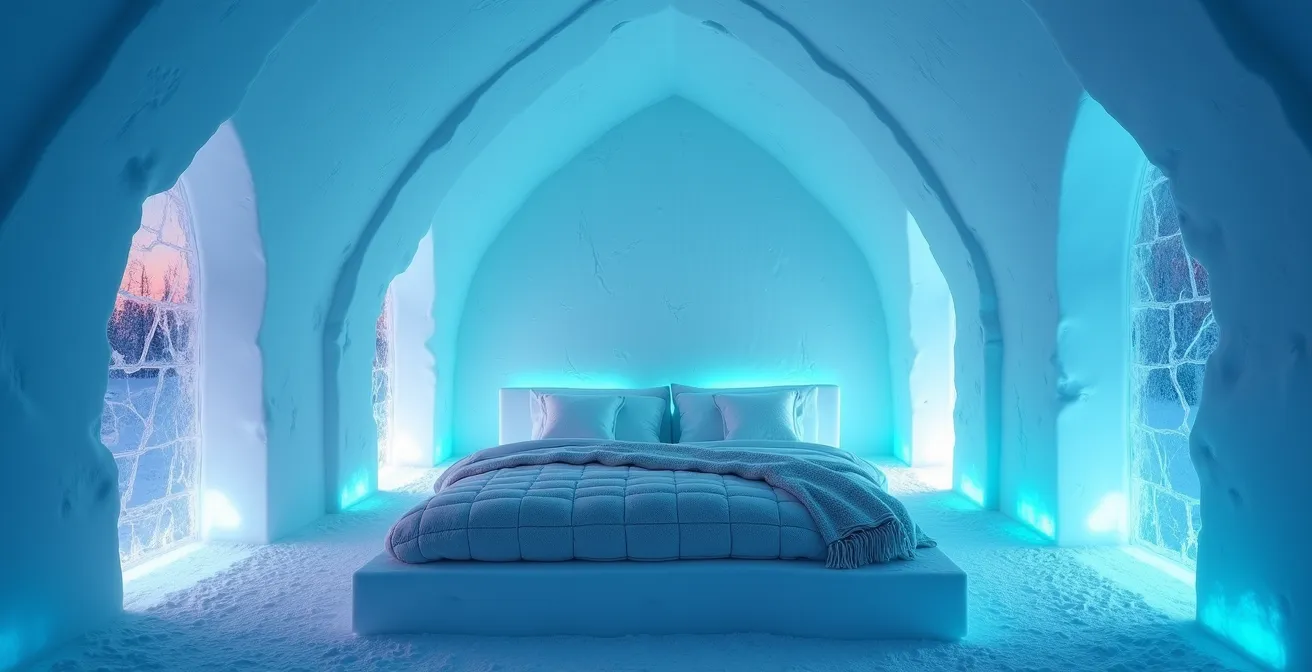
The secret to staying warm in an ice hotel isn’t piling on clothes; it’s actively managing moisture and understanding thermal dynamics.
- Wearing too many layers compresses insulation and traps sweat, making you colder.
- Your electronics are at greater risk from condensation during re-warming than from the cold itself.
Recommendation: Treat your night as a technical challenge. Use a single, high-performance base layer, plan your bathroom trips strategically, and view the backup warm room as part of your toolkit, not a sign of defeat.
The idea of sleeping on a bed carved from solid ice, surrounded by walls of compacted snow, is the kind of adventure that calls to the bold. Quebec’s Hôtel de Glace is a masterpiece of ephemeral architecture, an experience you’ll talk about for years. But as the booking is confirmed, a primal question surfaces for every guest: “How will I possibly stay warm?” Most people assume the answer is to bundle up like a polar explorer, wearing every sweater they own. This is the single biggest mistake you can make.
As an instructor who has taught cold-weather survival for years, I’m here to tell you that surviving—and thriving—in a -5°C suite has almost nothing to do with the quantity of layers you wear. It’s about science, strategy, and technique. It’s about managing moisture, preserving your body’s heat engine, and using the hotel’s unique systems to your advantage. Forget everything you think you know about staying warm. The real key isn’t brute-force insulation; it’s about mastering the thermal efficiency of your own body and your gear.
This guide will equip you with the technical knowledge to conquer the cold with confidence. We’ll dismantle the layering myth, create a tactical plan for the dreaded 3 AM bathroom run, evaluate the room options, protect your electronics from thermal shock, and reframe the “warm room” as a strategic asset. By the end, you won’t just be prepared; you’ll be an expert, ready to enjoy this incredible Quebec experience without a single shiver of doubt.
text
To help you navigate this unique challenge, here is a complete breakdown of the strategies and knowledge you’ll need. This guide is structured to take you from the fundamental principles of staying warm to the practical logistics of your stay.
Summary: Your Tactical Guide to Conquering the Hôtel de Glace
- Sleeping Bag Technique: Why Wearing Too Many Layers Actually Makes You Colder
- The 3 AM Bladder Problem: How to Handle Nature Calls in an Ice Fortress
- Standard vs. Premium with Fireplace: Is the Visual Ambiance Worth the Cold?
- Why Electronics and Glasses Must Stay in the Locker, Not the Room
- The ‘Warm Room’ Safety Net: Why Having a Backup Key Is Essential for Peace of Mind
- The ‘Warm-Up’ Map: Free Indoor Spots Near the Main Sites to Thaw Out Toddlers
- How Do They Build It? The Engineering Behind the Stacked Ice Blocks
- Nordic Glamping in Quebec: Choosing Accommodations That Are Actually Accessible in Winter
Sleeping Bag Technique: Why Wearing Too Many Layers Actually Makes You Colder
Alright, listen up, because this is the most critical lesson of the night. Your arctic-rated sleeping bag works by trapping a layer of air that your body heats up. This is called ‘loft’. The fatal mistake is wearing so many layers that you compress the bag’s insulation from the inside. A compressed bag has no loft, and no loft means no trapped air, rendering its expensive insulation useless. Worse, all those layers will make you sweat. Even a little moisture will steal your body heat dramatically faster than air. You end up cold, damp, and miserable.
The correct technique is to maximize the bag’s performance by minimizing what you wear. Your body is the furnace; the sleeping bag is the house. You need to let the furnace run efficiently. Strip down to a single, clean, dry base layer. The ideal material is merino wool or a high-quality synthetic like polypropylene. Absolutely no cotton—it’s a sponge for moisture and is nicknamed “death cloth” in winter camping for a reason. This single layer will wick any sweat away from your skin, keeping you dry, while allowing the sleeping bag to do its job of trapping a thick, warm layer of air around you.
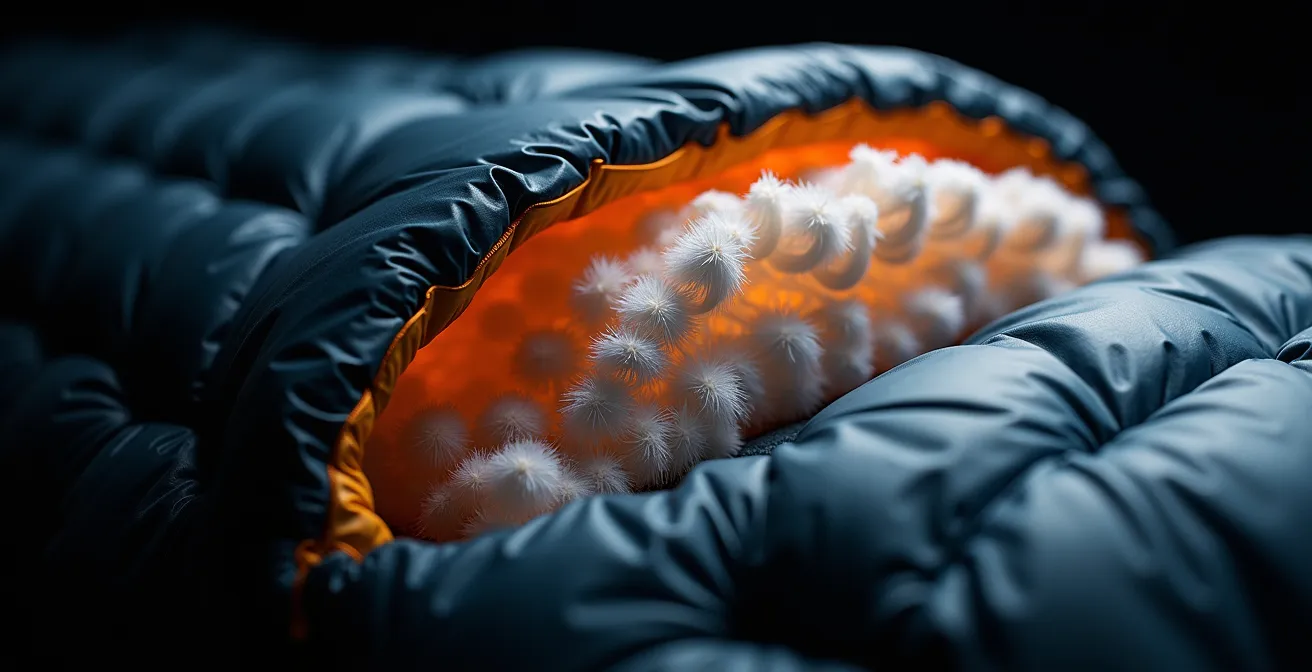
This cross-section clearly shows how fluffy, uncompressed insulation creates pockets of warm air. When you over-layer, you flatten these pockets. Also ensure your socks and underwear aren’t tight, as this restricts blood flow to your extremities, making them feel cold first. A simple wool hat is a great addition, as you lose significant heat through your head. With this technique, you harness the full power of your gear and your body’s own heat, a principle that allows for survival even in the most extreme conditions, a fact supported by decades of Canadian Army winter training experience.
The 3 AM Bladder Problem: How to Handle Nature Calls in an Ice Fortress
It’s the scenario every guest dreads: the unavoidable call of nature in the middle of the night. Leaving the warmth of your sleeping bag cocoon to navigate an icy corridor feels like a monumental task. But with a tactical approach, it’s just a minor interruption, not a crisis. The hotel has this down to a science. During your mandatory training session, staff provide detailed maps showing the exact, safest route from your suite to the heated washrooms in the main Hôtel Valcartier complex. Pay attention and memorize this route.
Your personal strategy begins before you even get into the sleeping bag. Preparation is everything. Instead of complex, lace-up winter boots, have a pair of slip-on insulated boots (like Bogs or Muck Boots) right beside your ice bed. Have a thick parka ready to throw on. The goal is to go from bag to boots to parka in under 30 seconds. The ambient temperature in the hotel is kept between -3°C and -5°C, which is cold but manageable for a quick trip. Walk briskly to keep your core temperature up. When you get back, don’t just jump into your bag. You’ve lost some heat, and you need to regenerate it quickly. This is where a small burst of activity is your best friend.
Your Action Plan for: The Midnight Bathroom Run
- Pre-exit: Place slip-on insulated boots and a thick parka directly beside your sleeping area before settling in.
- During: Walk briskly but carefully to maintain core temperature; the hallways are consistently cold but not extreme.
- Re-entry: Do 10-20 quick calisthenics like squats or pushups right before getting back in the bag to rapidly raise your core temperature.
- Recovery: Use the ‘burrito wrap’ technique—pull the sleeping bag hood tight and breathe inside the bag for 2-3 minutes to create a warm, humid microclimate.
By treating the bathroom run as a planned tactical maneuver rather than a dreaded event, you stay in control of your comfort and can get back to sleep quickly, feeling warm and accomplished.
Standard vs. Premium with Fireplace: Is the Visual Ambiance Worth the Cold?
When booking, you’ll face a choice between the standard rooms and the premium themed suites, some of which feature a beautiful fireplace. This is a critical decision where you must manage your expectations. The standard rooms are your base-level adventure: a bed frame carved from ice in a more communal setting. The premium suites offer more space, incredible themed ice sculptures, and a feeling of being in your own private ice cavern. But let’s be clear about that fireplace: it is a bio-ethanol fireplace purely for decoration. It produces no heat. Let me repeat: you are paying for ambiance, not warmth.
Is it worth it? That depends entirely on your goal. If you are a purist seeking the most authentic “sleeping on ice” experience and are on a budget, the standard room is a fantastic choice. If you are celebrating a special occasion and want the most visually stunning, Instagram-worthy photos, the premium suites are unmatched. The artistry in these rooms is breathtaking. The experience has been refined over many seasons, attracting over 1 million visitors and 43,000 overnight guests since its inception. The hotel knows how to deliver a memorable stay, regardless of the room category.
To help you decide, here is a direct comparison based on what truly matters for your stay, drawn from an analysis of the different room experiences.
| Feature | Standard Room | Premium Suite with Fireplace |
|---|---|---|
| Price (CAD) | $299-349 | $399-549 |
| Heat Output | None (maintains -5°C) | Bio-ethanol fireplace – decorative only, no heat |
| Privacy | Communal hall atmosphere | Secluded ice cavern feel |
| Ice Sculptures | Basic ice bed platform | Themed artistic carvings |
| Space | Compact | More spacious with seating area |
Ultimately, your warmth will come from your sleeping bag and proper technique, not from your room choice. Choose based on your budget and desire for aesthetic beauty, not on a false hope of a warmer night.
Why Electronics and Glasses Must Stay in the Locker, Not the Room
This is a non-negotiable rule of cold-weather survival that applies directly to your stay: leave your phone, camera, and even your eyeglasses in your secure locker in the warm building. The reason isn’t what most people think. While extreme cold does impact battery performance—winter travelers in Quebec have documented phones going from 100% to dead in under 30 minutes at -20°C—the greater danger is thermal shock and condensation. When you bring a frozen device from the -5°C ice room into a warm, humid space (like the breakfast area or even your car), moisture instantly condenses on and, more dangerously, *inside* its cold surfaces. This internal condensation can short-circuit electronics and cause permanent damage.
The same principle applies to eyeglasses. Bringing them from the cold into a warm room will cause them to fog up instantly. But the real issue is the fine layer of moisture that forms. If you go back and forth, you risk this moisture freezing and damaging coatings or frames. Your locker is your electronic safe zone. Charge everything overnight in the warm room. For the short time you’re in the Hôtel de Glace for photos before bed, keep your phone close to your body in an inside pocket to keep it warm. But for the overnight sleep, it’s not worth the risk.

Think of this image every time you’re tempted to bring your phone to bed. The beautiful but destructive power of condensation is the real enemy. This isn’t just an inconvenience; it’s a fundamental principle of physics. Lithium-ion batteries experience a chemical slowdown in the cold, causing them to shut off, but the permanent damage comes from the re-warming. Protect your expensive gear by following this simple rule.
The ‘Warm Room’ Safety Net: Why Having a Backup Key Is Essential for Peace of Mind
Every overnight package at the Hôtel de Glace includes a standard, heated hotel room in the main Hôtel Valcartier building. Many first-timers view this as an admission of defeat—a sign that they might “fail” the ice hotel challenge. As an instructor, I tell you to reframe this completely. The backup room is not a failure; it is a strategic asset and a crucial part of the luxury experience. Having that key gives you the psychological freedom to fully embrace the adventure, knowing you have a comfortable safety net at any time.
Think of it as giving yourself “permission to bail.” There is no trophy for stubbornness. If you’re uncontrollably shivering, if the novelty wears off at 4 AM and you’re sacrificing real sleep, using the warm room is the smart, strategic choice. You’ve already had the experience of being in the ice suite for hours. As travel writers at the Dana Edition aptly put it in their experience guide:
Giving yourself ‘Permission to Bail’ – frame the backup room not as a failure, but as a strategic part of the luxury package
– Dana Edition Travel, Hotel de Glace Experience Guide
Many savvy guests use the warm room proactively. It’s the perfect place to store your luggage, charge your electronics safely, and have guaranteed access to a warm shower and a fresh coffee in the morning without having to trek from the ice suite first. You can spend the evening enjoying the ice bar, exploring the hotel, and then sleep in the ice suite for as long as it feels comfortable and fun. Knowing you have a warm, quiet room waiting for you transforms the experience from a test of endurance into a unique, low-pressure adventure.
The ‘Warm-Up’ Map: Free Indoor Spots Near the Main Sites to Thaw Out Toddlers
The Hôtel de Glace is part of the larger Village Vacances Valcartier resort, a massive winter playground. If you’re visiting with family, especially young children, your strategy must include a “warm-up map.” Kids lose body heat faster than adults, and their tolerance for cold is lower. Forcing them to endure it will only lead to misery. The key to a successful family trip is to alternate short bursts of outdoor fun with frequent, planned stops in heated areas. Fortunately, the resort is designed for this.
You are never more than a few minutes’ walk from a warm, free-to-access indoor space. Your mission is to know where these oases are located. The main hotel lobby is open 24/7 and is a quiet refuge late at night. The walkway connecting to the Bora Parc indoor waterpark is heated and accessible without a ticket, offering a blast of tropical air. Even the food court has corner booths that can serve as a base for enjoying a poutine and a hot chocolate while everyone’s cheeks regain their color. This strategic “winter hopping” is essential. The resort itself is a massive complex with over 35 snow slides and skating paths, but it’s the seamless integration of heated zones and the 30°C indoor waterpark that makes it a viable family destination.
Here is your tactical guide to the key warm zones within the Valcartier complex:
- Main Lobby: Open 24/7, with comfortable seating. The perfect emergency warming spot.
- Mezzanine Levels: Less crowded than the lobby, offering good views for supervising older kids.
- Bora Parc Corridor: A heated walkway leading to the indoor waterpark (maintained at 30°C year-round) that you can access without a waterpark ticket.
- Arcade Area: An enclosed and heated space that provides entertainment for restless children.
- Food Court Strategic Spots: Corner booths away from main traffic are ideal for enjoying a break in peace.
By using these spots, you can extend your family’s enjoyment of the winter activities for hours, ensuring everyone stays safe, warm, and happy.
How Do They Build It? The Engineering Behind the Stacked Ice Blocks
Standing inside the Hôtel de Glace, it’s easy to take the structure for granted. But you are standing inside a marvel of temporary engineering. Each year, the hotel is constructed from scratch over six weeks by a team of 50 people. The scale is immense: the construction uses 30,000 tons of man-made snow and 500 tons of ice to create walls that are up to four feet thick. This isn’t just a pile of snow; it’s a precisely engineered structure designed for stability and artistry.
The secret ingredient is a specialized slush mixture of snow and ice that engineers have dubbed “snice”. This acts as a binding mortar that freezes solid, holding the structure together. The construction process is fascinating. Giant metal molds are used to shape the arches and vaults. They are filled with man-made snow, which is less airy and more structural than natural snow, and left to harden for several days. Once a section is solid, the molds, which are mounted on jacks with ski bases, are lowered slightly and dragged by a tractor to the next position. This modular process allows for the creation of massive vaults over 7 meters high, with walls that taper from over 1.2 meters thick at the base to 75cm at the top of the arch.
The ice itself is also custom-made. It’s created in special freezers to be crystal clear for the sculptures and ice glasses used at the bar, or perfectly white and opaque for structural blocks. Understanding the sheer effort and ingenuity involved—the tons of material, the custom-built molds, the invention of ‘snice’—deepens your appreciation for the experience. You aren’t just sleeping in a cold room; you are a temporary resident in a monumental work of structural art.
Key Takeaways
- Moisture is the enemy: A single, dry, non-cotton base layer is far warmer than multiple bulky layers that cause you to sweat.
- Protect your gear: Keep all electronics in your warm locker overnight to prevent permanent damage from condensation, not just battery drain.
- The backup room is a tool, not a failure: Use your included warm room strategically for peace of mind, storage, and comfort.
Nordic Glamping in Quebec: Choosing Accommodations That Are Actually Accessible in Winter
The Hôtel de Glace offers an unparalleled adventure, but it’s important to place it in the context of other Nordic “glamping” options available in Quebec. The term “glamping” can be misleading in winter. A beautiful remote cabin is useless if you can’t reach it through three feet of snow. Your choice of accommodation should be weighed against two critical factors: guaranteed warmth and true winter accessibility. The Hôtel de Glace excels in accessibility, located at a major resort with plowed, paved roads. Its warmth is conditional, relying on your gear and technique, but backed by a guaranteed warm room.
Other popular options offer different trade-offs. Heated yurts in regions like Mauricie provide an authentic, cozy “coureur des bois” experience with wood stoves, but often require a 4×4 vehicle for access. Transparent bubbles in Charlevoix offer incredible stargazing with heated floors but come at a similar price point to the Ice Hotel. Micro-chalets at ski resorts like Tremblant offer maximum comfort and accessibility but lack the unique bragging rights of sleeping in ice. As the Bonjour Quebec Tourism Board notes, “The Hotel de Glace offers ultimate bragging rights with a safety net, whereas a remote cabin offers a more authentic ‘coureur des bois’ experience”.
| Accommodation | Guaranteed Warmth | Winter Access | Cost/Night | Bragging Rights |
|---|---|---|---|---|
| Hotel de Glace | No (-5°C) with warm backup | Excellent – paved, plowed roads | $399-549 CAD | Ultimate – only ice hotel in North America |
| Heated Yurts (Mauricie) | Yes – wood stove heating | Moderate – may need 4×4 | $150-250 CAD | Moderate – cozy comfort seeker |
| Transparent Bubbles (Charlevoix) | Yes – heated floors | Good – resort maintained | $300-400 CAD | High – Instagram worthy |
| Micro-chalets (Tremblant) | Yes – full heating | Excellent – ski resort access | $200-350 CAD | Low – comfortable choice |
Choosing the right experience depends on your appetite for adventure versus your need for guaranteed comfort. The Hôtel de Glace stands alone as a true test of technique, but one that is accessible to anyone willing to learn.
Now that you’re armed with the technical knowledge and strategic mindset of a seasoned pro, you are fully prepared to take on this unique challenge. Book your adventure with the confidence that you won’t just survive the night—you’ll conquer it.
Frequently Asked Questions About the Hôtel de Glace Experience
Where exactly is the backup warm room located?
The backup room is in the main 4-star Hôtel Valcartier building, not a separate facility. It’s integrated into your ice hotel package for seamless transition if needed.
When should I consider using the warm room?
Consider transitioning if you experience uncontrollable shivering, cannot warm up after 30 minutes in your sleeping bag, or if the novelty has worn off and you’re sacrificing sleep quality for stubbornness.
Can I use the warm room for storage and then return to the ice suite?
Yes, many guests strategically use the warm room to store luggage, charge electronics safely overnight, and have guaranteed access to warm showers and morning coffee.